France in Chaos before Agincourt campaign

Charles VI, miniature from des Dialogues de Pierre Salmon – Wikipedia

When Henry V landed on the shore of Normandy in 1415, he was relatively sure the French were in no position to offer him much resistance. Already in his father’s reign, both factions of a budding civil war had already approached the English for assistance against the other. Henry IV had responded with an invasion force in support of the Armagnacs against the Burgundians. The Armagnacs—the party of Charles, Duke of Orléans—had made a better offer. However, Prince Henry was in favour of John the Fearless, Duke of Burgundy, and this antagonism against his father’s policy placed him on the wrong side of the political fence. Henry IV’s death a year later put an end to that!

So what was this all about? Since 1392, poor France was afflicted by a schizophrenic king, Charles VI, who slipped in and out of madness with unpredictable frequency. He was sane often enough to negate removing him from the throne permanently, though the older he got, the less he was able to rule rationally even when cognizant. His illness created a political firestorm, as his nobles fought to control his presence; whoever possessed the king ran the country. In the early years of the king’s “absences” (as his schizophrenic episodes were called), the government was ruled by his brother, Louis, Duke of Orléans along with the queen. Orléans was bitterly opposed by John the Fearless, the king’s cousin, who was the popular favorite. In 1407, John had Louis murdered one night in the streets of Paris, but he was such a manipulator that he got away with it. Of course, Louis’s son Charles did all he could to condemn the Duke of Burgundy, but he was too young and inexperienced to pull it off. He eventually formed an opposing faction led by his father in-law, the brutal and effective Count of Armagnac, who carried on after Charles was captured at the Battle of Agincourt.

In 1412, when Henry IV sent an invasion force to France under his second son the Duke of Clarence, King Charles managed to patch up a peace between his warring factions. Clarence was bought off and returned home, but the temporary truce soon failed and matters came to a head just after Henry IV died. Paris had become a proverbial powder keg, and simmering grievances broke into rioting, directed by agents of Burgundy but led by the powerful butcher’s guild. Under their ringleader, Simon Caboche, the Cabochiens sported white hoods, laid siege to the Bastille—sound familiar?—then turned their attentions to the Hôtel Saint-Pol where the Dauphin was staying. The insurgents seized and imprisoned many of the Dauphin’s supporters and detained the teenaged heir, confining him in the palace with his incapacitated father and helpless mother. Thus began a reign of terror where any suspected Armagnacs were arrested, imprisoned, and murdered. This went on for four months.

The Cabochien revolt, from Les Vigiles de Charles VII,BnF, Manuscrit Français 5054 – Wikipedia

But insurrections are bad for business, and eventually the Parisians had had enough. When the time was ripe, the Armagnacs gathered their forces and converged on the city, inspiring the anti-Cabochiens to rise up against their oppressors. It all happened very quickly. Caboche and hundreds of his followers slipped out of Paris, taking refuge with the Duke of Burgundy who was one of the first to leave. The Armagnacs moved in, arrested anyone suspected of misconduct, and launched their own reign of terror. They kept a strangle-hold on Paris for the next five years, though Burgundy periodically laid siege to neighboring towns and the city itself in an attempt to push them out.

John the Fearless, Duke of Burgundy, Portrait after Rogier van der Weyden – Wikipedia

Duke John was not one to take matters sitting down, so to speak. There was always King Henry of England, ready to discuss terms. Just like his father back in 1412, Henry negotiated with both sides while he prepared to invade. He hoped that John would offer to swear fealty to him, but Burgundy was not willing to go against his own king. So the best Henry could manage was something resembling a non-interference agreement; no one knew for sure what they came up with. But by all indications, Burgundy cooperated. He concentrated his efforts against the Armagnacs, throwing the government into such a panic that they dared not commit troops to the English invasion while Paris was threatened.

Harfleur was the first to experience the might of the English army. Henry laid siege to the city, blockading it both by land and sea. Repeated calls for help generated nothing but excuses: the king was working on it. They hadn’t gathered enough troops yet to confront the English. King Charles and the Dauphin both made their way toward Harfleur, but didn’t travel any further than Vernon, about eighty miles upriver, while the army slowly gathered at Rouen, thirty miles closer. Before he left Paris, the Dauphin sent messages in the king’s name to both the Duke of Burgundy and the Duke of Orléans, requesting them to send five hundred men each—but not to come themselves. This gave John the excuse he needed to pretend that he had been insulted, and he ordered all his lords in Picardy to stay put until he ordered otherwise. Neither he nor his men—with few exceptions—showed up at Agincourt. Too bad for the French; Burgundy’s leadership skills were sorely needed. Orléans belatedly decided to go. But he was an inexperienced twenty-one year old, and when he took command of the army—as was his right—he fatally ignored the advice of both the Constable and Marshal of France. He survived the battle, only to spend the next twenty-five years an English prisoner.

Because Burgundy stayed away, a disproportionate number of Armagnacs met their deaths on the battlefield of Agincourt. Once again, John the Fearless attempted to take advantage of the situation by laying siege to Paris. But once again, he was foiled. His day would come, but not for another three years, and when a new insurrection broke out in 1418, it made the Cabochien revolt look like a dress rehearsal. I’ll explore the Paris massacres in my next book, HENRY, SCOURGE OF NORMANDY.

Review: Cursed Kings: The Hundred Years War IV by Jonatyhan Sumption

It seems that every era in the middle ages has its historian whose exhaustive study puts it in the first rank. We had Edward A. Freeman with the Norman Conquest and James Hamilton Wylie with Henry IV and V. And now we have Jonathan Sumption covering the Hundred Years War in five volumes. I can’t believe I didn’t stumble across him until now! His scholarship is absolutely mind-boggling. He has covered events in such detail that much of the guesswork has been removed. This volume starts at the beginning of Henry IV’s reign and ends at Henry V’s death. We get a substantial look at what was going on in France, which had a huge impact on why and how the English were so successful in France. For instance, when describing the Dauphin Charles (in 1418):

Charles was earnest, intelligent and shrewd and would eventually become an astute judge of men. But he lacked self-confidence even as an adult. He was moody, changeable, and occasionally depressive, naturally risk-averse, withdrawn and taciturn in company, uncomfortable in the presence of strangers. Some of these qualities…made him temperamentally averse to war and uninterested in the chivalric values to which his father had been devoted in his brief prime. They also meant that he was easily led by intimates with stronger personalities than his own, a weakness which provoked persistent faction fighting among the men around him.

In my research, this book has absolutely taken first place. The author has filled in a lot of blanks glossed over in other history books, though in a few places I still need to go back to the older historians. I’d say that’s the nature of the beast in historical studies. You only have to look at the sixty-pages of notes and the forty-page bibliography to see how extensively researched this book is. And, I’m happy to say, I found it very readable—the most important part of all.

Mary Anne Yarde REVIEW for The Agincourt King

The Agincourt King (The Plantagenet Legacy Book 5) by Mercedes Rochelle is a lavish depiction of one of the most famous battles in English history, which was won by one of England’s most beloved kings.

Immortalised by Shakespeare, and to some extent, Kenneth Branagh, Henry V is probably one of the more recognised kings of this era. Shakespeare is a hard act to follow, but I was really looking forward to seeing Rochelle’s take on the man famed for his St Crispin’s Day Speech. Rochelle has breathed new life into Henry. He is a capable and somewhat caring king, devoted to the well-being of his people, yet driven by ambition to achieve the same greatness as his great grandfather, Edward III. Edward triumphed in the French battle at Crecy, and Henry was determined to achieve a similar feat, ultimately surpassing Edward’s victory at The Battle of Agincourt.

The level of historical detail in this story is astonishing. Rochelle’s dedication to research is reflected in her authoritative penmanship. The historical background of this story is so impressive, that it practically screams authenticity. There was no question about the time period I was in while reading this book. Rochelle’s skilful writing revives this era in all its agony and splendour.

Beyond being a narrative of conflict, this story explores the complexities of family, emphasizing the bond between brothers. Humphrey, Henry’s youngest brother, admires the king with fierce pride. Humphrey adores his brother but this devotion does not blind Humphrey to Henry’s faults. At times, he finds Henry rather confusing. Although cold-blooded murder bothers Henry, he doesn’t have the same moral dilemma about causing the death of thousands in battle. Witnessing the death of his closest friends and comrades from the bloody flux during the Siege of Harfleur was not a cause for retreat. Humphrey sees that Henry values honour above all else, especially when it comes to defeating the French.

Henry is portrayed as an extraordinarily astute leader, effortlessly navigating the realm of power and politics, and orchestrating the French like a masterful musician. He whistled the melody and the song unfolded just as he desired. He wants to be perceived as a compassionate leader, refraining from aggressive actions against the innocent. However, he has no qualms about causing mass starvation and murdering prisoners of war to achieve his goals. By observing his actions and inactions, the reader, and indeed Humphrey, gain insight into Henry’s true character. He is a driven individual who is hungry for success and recognition. The Battle of Agincourt served as the platform for him to showcase that God was on his side. Once he had done that, he went home. At least for a while.

The way the book explored the relationships between the brothers, particularly Henry and Thomas, was expertly executed. From Humphrey’s musing, he sees greatness in both his elder brothers and comes to the conclusion that both men have the makings for a great king, it is just that fate made Henry the eldest. The portrayal of the brother’s relationships was skilfully done, allowing the reader to truly grasp the dynamics of this family. Henry’s relationship with his brothers was unique compared to previous kings – he cared for them and valued their thoughts, although he had the ultimate authority as king. And as Humphrey notices, although Thomas is the heir to the throne, and looks the part, Henry is the better man for the job. I really enjoyed as a reader getting to know the brothers and the different strengths they had. The way Humphrey told his story from his perspective added a personal touch that I found particularly enjoyable while reading. Humphrey was the ideal narrator for Henry’s story and I really liked him as a character. I thought he was wonderfully depicted.

Rochelle does give the reader both the English and French perspectives in this novel. With Charles VI’s unpredictable illness, there is a lack of strong leadership. The depiction of the Dauphin, Louis, Duke of Guienne, was masterfully rendered. In contrast to Henry, he fails to command the loyalty of his nobles, is burdened with rival noble Houses, lacks combat experience, and is surrounded by men he doesn’t trust. Henry cleverly outwits and outmanoeuvres him every time. Nevertheless, the Dauphin was a captivating character to read about and I thoroughly enjoyed witnessing the complete chaos that enveloped him and the French throne.

Rochelle subtly indicated the future by mentioning Henry VI’s disputed lineage – after all, he was an usurper which would have made Henry V the son of an usurper. Henry needed this decisive battle that would validate the Lancastrians’ claim of divine backing. Rochelle illustrates how crucial this war was for Henry’s reign. He needed that success. What happened after in the future generations is, as they say, another story!

I anticipated greatness from this novel because Rochelle can create authentic battle scenes and, at the same time, grasp the complexities of human emotions, and as I anticipated this book is great. It is an utterly brilliant book from start to finish and one I highly recommend.

Click for Yarde Book Promotion: https://maryanneyarde.blogspot.com/2024/04/book-review-agincourt-king-plantagenet.html


Weapons and Armour in 15th Century: Guest Post by Garrett Pearson

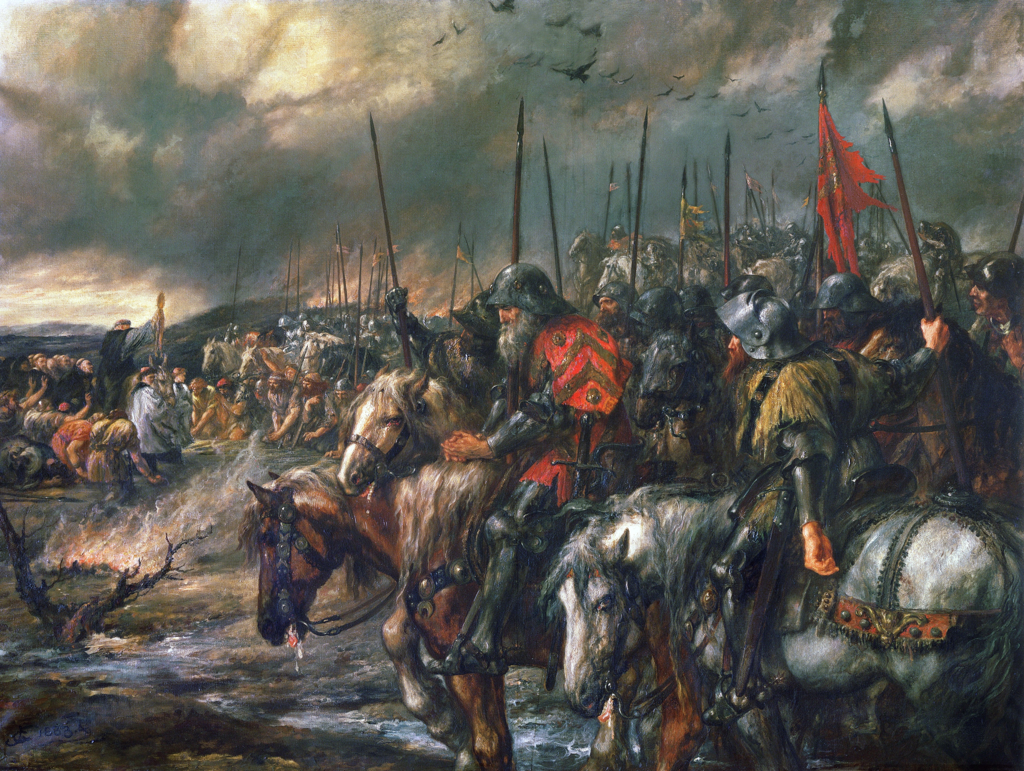
Morning of the Battle of Agincourt by John Gilbert – Wikipedia

The early fifteenth century would see a mix of weapons and armour and mail depending upon who was wearing it. Let’s start with the archers (the battle winners, no matter what anyone says!)

Archers

The archers would be a mix of hired on Yeomanry who would supply their own kit and archers who were on a Lord’s payroll and who would have some equipment supplied. The archers helmet was usually of two basic types (if they had one, the poorer ones may only have had waxed leather/cloth hoods) Anyway, the helmets – the “Kettle hat” as it is called is shaped just like a first world war British/American soldiers, it is almost identical with a bowl for the head and a rim all the way around. Check out the first world war soldiers for a look. The second helmet is still basic, shaped to the head and covers it and the neck to the collar, the front is plain leaving the eyes, cheeks and mouth open and fits down the side of the face, there is no nasal bar, there would be cut outs for the ears enabling the archer to hear well.

The Captains or leader of an archer band may have a mail shirt and possibly some shoulder plates and elbow plates but not much more than this. Some archers would just have a padded jacket (gambeson?) this would be stuffed/padded with wool or fabric shreds and stitched in long seams down the garment. This stitching bunches the wool/fabric and helps to deflect or at least slow down incoming arrows or crossbow bolts, it would also deflect bladed weapons to some degree. Archers would start off the campaign with boots or at least shoes, by Agincourt many would be barefoot and even fighting trouserless! (owing to the dysentry that was rife in the army) All would carry a dagger, a “poniard” or a “ballock dagger” and/or a knife, many had small hand axes used as both a tool and weapon. Don’t forget the large wooden mallets the archers would have for driving in their wooden stakes (their anti horse device) this could also double as a weapon to bludgeon a Knight to death. The Captains may carry a short sword (badge of rank).

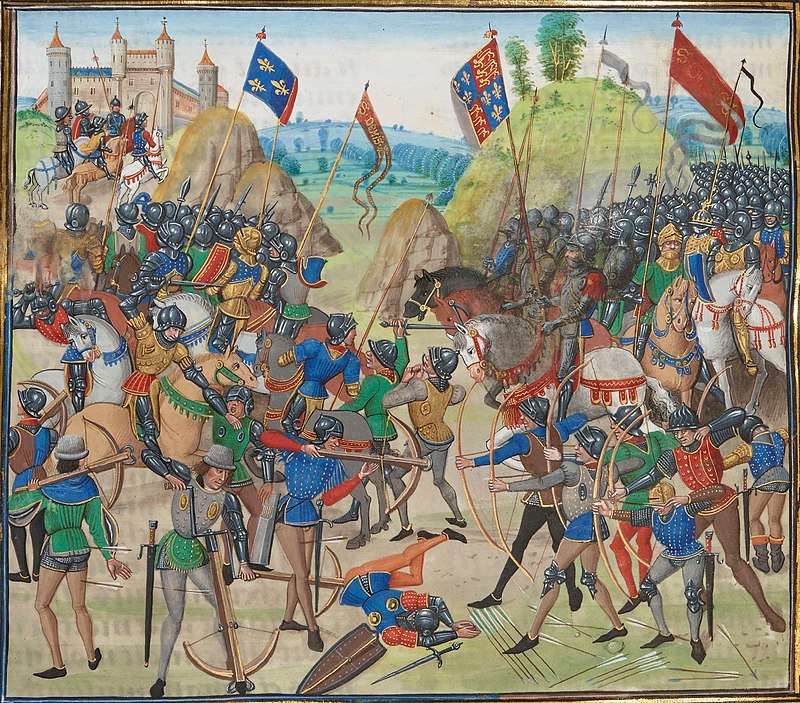
Battle of Crecy from Froissart’s Chronicles (Wikipedia)

Men at Arms (Under a Lord)

These men are usually in a Lord’s retinue and liveried via a gambeson or shirt over their mail shirt to show their association. Not many of these would have plate armour, however some would have picked up pieces from previous battles and again the Captains would be better armed/protected than the ordinary soldier. So, usually dressed in a mail coat with a fabric or leather shirt etc over it to show their Lord’s colours. All would have a helmet but usually a basic one covering the head and neck but open faced, under this would be a mail coif that covered the back of the neck and top of the shoulders as well. Again, the veterans would likely have plate on the shoulder, elbows and knees too that they had taken from the dead in previous battles. Weapons would be axes, war hammers, halberds (pole arm with an axe one side and a spike on the other) or variations of this – axe/spike/hook etc. The hook is used to haul a Knight from his horse. Maces would be another common weapon. Short swords would be used and carried by most men at arms, all would carry a “poniard” or a “ballock dagger” both had long slim blades for slipping through helmet visors to kill quickly. All would have boots.

Knights/Lords/King

These lads are mainly in complete plate armour made to fit them personally like a modern day ‘made to measure suit’. Helmets would be visored, however I have read that many would lift their visor to enable better vision during battle (it must have been terrifying and claustrophobic in a battle when trying to look through slits? Your hearing would also be reduced) Hence archers being trained to hit a turnip at 200 yards! (see the similarities?) and thus Henry suffering an arrow wound in the face. Popular helmets were ‘Pig faced bascinets’ where the front of the helmet is shaped like a long snout with only two narrow slits for the eyes and small perforations in the snout to help breathe. They would have plate armour that was well articulated for all movement. Weapons would be maces, battle axes, shortened lances, war hammers and some would carry a shield if the weapon they were using was one handed (mace/hammer etc), if they had shortened lances they would need two hands and abandon the shield. They would have plate shoes and plate gauntlets. All would carry a sword as a badge of rank, again a dagger would be compulsory.

In this age when a Knight was so well protected the best and quickest way to kill him was; arrows to the face/bludgeoning to death/stabbing through the visor or under the armpit or groin which was hard to protect.

Archers would aim for horses as a larger target and had special shaped arrows designed to cut arteries or bury deep in unprotected areas. Once a knight was unhorsed he would likely be concussed at the least, and an easier target to beat/bludgeon/stab to death. From what I have read of Agincourt after each French charge the archers would slip out to recover arrows and dispatch wounded and concussed knights via axes/daggers/mallets etc.

******

Garrett Pearson is an author of historical fiction:  4 Books about Hannibal and one on Stamford Bridge.

Visit Garrett on Twitter:  https://twitter.com/Garrett13853937

Indentures and the King’s Army

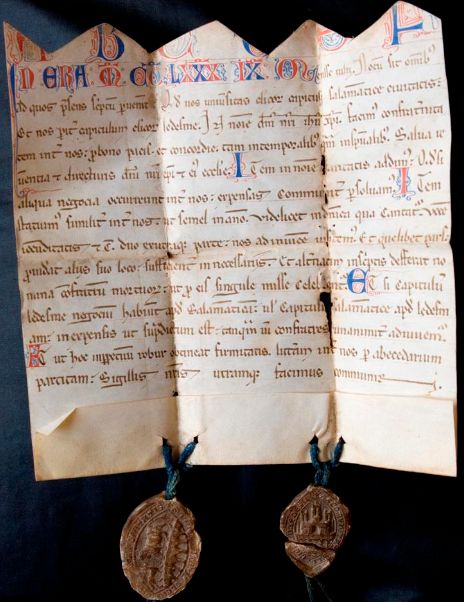
Source: Wikipedia

Put simply, an indenture was a contract written in two identical parts and divided irregularly—or indented—so that both halves could be joined together in the future. This post is mainly concerned with indentures made between King Henry V and his nobles for the invasion of France.

Funding an army was an intricate operation.  An astonishing amount of paperwork has survived from the reign of Henry V, informing us of the exactitude practiced by the exchequer clerks. Several steps along the way guaranteed that every soldier was accounted for. But how were they paid?

For the most part, the king did not pay the soldiers directly. He would be responsible for his own household, as well as recruiting specialists such as gunners, 119 miners, 100 stonecutters, 120 carpenters and turners, 40 smiths, 60 waggoners, and the like (Anne Curry, 1415 Agincourt, p.71). For the rest, the nobles indented to bring a certain number of men-at-arms and archers with them. By now, the old feudal system had mutated into what many historians now call Bastard Feudalism, more of a fee-based agreement between the king and noble, or noble (I’ll call him the Captain) and his retainers (or retinue). For military service, the indenture might be drawn up for one year or less, depending on the plan of campaign. For the Agincourt campaign, the indentures were for twelve months.

So when the Captain applied his seal to the indenture, he was paid, up front, one half of the first quarter’s wages (the king having raised the money through taxes and loans). The second half of the first quarter would be paid at the muster, when the Exchequer’s officials actually counted the men to determine that everyone showed up. For the second quarter, because funds were short, the Captain was given jewels or some equivalent collateral to be redeemed at a future point (some were still outstanding in the reign of Henry VI). He was expected to pay the second quarter’s wages out of his pocket. The third quarter’s wages were supposed to be paid after six weeks of that quarter, and so on, though as the months progressed, things got a little messy.

But, as everyone knew, the real fortunes to be made would come from booty and, especially, ransoms. This, too, had a very specific breakdown. For anything worth more than ten marks, the Captain was entitled to a third share from every man in his retinue, regardless of rank. The king took a third part of the Captain’s gains, and a third of a third from each soldier and archer. Prisoners of certain rank, like dukes, would automatically get turned over to the king, and the soldier would expect some sort of compensation.

Men were recruited in a three-to-one ratio: three archers to each man-at-arms. The latter included earls, bannerets, and knights. The earls, knights, etc. that were recruited by the great dukes would in turn recruit the men-at-arms and archers. From what I can gather, many servants doubled as archers, but not all. Some household servants were directly paid by their masters, and were not in receipt of military wages. Those numbers are unknown. The greater the noble, the larger his contribution. The Duke of Clarence, Henry’s brother, indented for one earl, two barons, 14 knights, 222 esquires, and 720 mounted archers. The Duke of Gloucester, the next brother, brought 800 men total. After that, the numbers fell considerably; York and Arundel brought 400 each, Suffolk 160 and Oxford 140. Many of the knights indented directly with the Exchequer for somewhere between 40 and 120. So there were many small indentures, all of which had to be accounted for. The men were counted on their return, as well, including those invalided home after Harfleur.

Wages were calculated on a daily basis. A duke earned 13s 4d, an earl would get 6s 8d, a baron 4s, a knight 2s. an esquire 12d, and an archer 6d—this at a time when a skilled craftsman earned between 3d and 5d per day. So the incentive for archers was high. The king was responsible for shipping to and from France, including horses, harnesses, and supplies—another huge expense, when it is calculated that over 25,000 horses were needed for this campaign.

Each of the king’s copies of the indentures was kept in a drawstring pouch at the Exchequer with the Captain’s name on it. Any documentation that accrued during the campaign was added to the bag, such as muster rolls and wage claims. What a pile that must have been! Interestingly, since the Agincourt campaign ended before the third quarter began and many had been invalided home, the accounting was considerably complex. Some men were left behind to garrison Harfleur, and of course, there were those who had died during the siege or had been killed in the battle. Ultimately, the king decided to fix the start and end dates of the campaign, and even determined to pay the men who had been killed the full amount. This generosity was not forgotten, at least by the yeomen. The nobles, on the other hand, who had paid the second quarter in full, were shortchanged by the king’s decision to end the campaign forty-eight days early.  It was left to them to petition Parliament for their loss. For some of the nobles, it was easier to compensate them with castles and land, and in some cases, admission to the Order of the Garter. Not everyone was happy, but who was going to complain to the hero of Agincourt?

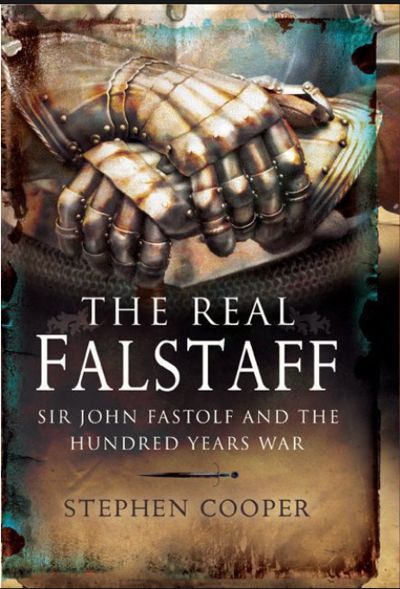
REVIEW: The Real Falstaff by Stephen Cooper

Anyone who has delved into Shakespearean studies probably learned that Falstaff was originally written as Sir John Oldcastle, Protestant martyr who was burned at the stake in Henry V’s reign. But Oldcastle had descendants who took exception to this unsavory depiction, and the great bard rewrote the part for the fat, cowardly, drunken braggart called Falstaff. Whether he intentionally named his character after the historical knight is up to interpretation, but the author has gone to great length to clear the name of Sir John Fastolf and demonstrate that he, too, has been misrepresented. Although there are similarities between the two:

“They were both captains in the king’s wars, much involved in recruiting and mustering soldiers, including drunken soldiers. They were both associated with a Boar’s Head tavern (though Falstaff’s was at Eastcheap, Fastolf’s in Southwark). They may both have been pages to Thomas Mowbray, Earl (and later Duke) of Norfolk. Each man used forceful and colourful language (Fastolf in writing, Falstaff in speech); and each attracted devoted servants. Most importantly in terms of reputation, Shakespeare portrays both men as cowards. We shall see that, in the case of Fastolf, this was most unjust; but Falstaff does not for a moment hide his cowardice.”

Sounds convincing, doesn’t it? But once the first chapter is finished, the comparisons cease and Shakespeare is not mentioned again. This book is a full-bodied biography of Fastolf, who was a major player in the conquest of Normandy, especially after Henry V’s death. He was an important commander under the Duke of Bedford, regent of France (and brother of Henry V). Not only did he spend much of his life in service during the war, he acquired great wealth which he spent judiciously back in England. After Bedford’s death, his career spiraled downwards, and he was to live the rest of his long life a disappointed man in England. But he continued to serve Henry VI’s interests, though the king’s advisors rarely listened to his advice. He lost many of his French acquisitions during the fiasco under Somerset’s incompetent command. An unfortunate episode during the battle of Patay, where he left the field with his men when all was lost, cast a shadow over his reputation and dogged him until the end. This is undoubtedly one of the main reasons his name has been linked to Falstaff, and the author hopes to give us a more balanced portrayal. Although this is not the most exciting period of history to read about, the book moves right along and gives us a lot of good information.

The Anglo-Saxon Table

We can fill volumes with what we don’t know about what people ate in the Anglo-Saxon period. Forget about recipe books; we have to wait until Richard II’s reign for the first cookbook. Of course the Romans were way ahead of the game, and Apicius wrote several volumes about soups and sauces and the art of cookery. The oldest surviving manuscripts date back to the eighth and ninth centuries, though I suspect they were probably hidden away in some dusty monastery.

We must remember that the Norman Conquest marked a substantial change in customs, habits, and even access to provisions. By access, I mean the forest laws, imposed by William the Conqueror to protect his hunting animals and vegetation that supported those animals. This had to have come as quite a shock to the natives, who were not used to being prohibited from catching their own game.

The Anglo-Saxon aristocrats hunted, of course, and even practiced falconry. King Edward the Confessor was said to have loved the hunt and indulged himself at every opportunity. So we know that wild birds found their way to the table (often roasted), as well as boar, deer, and fox. As far as domestic meat goes, the pig was the only farm animal that was used exclusively for food; they bore large litters and grew fast, and it is believed they were slaughtered as needed rather than certain times of year. Beef was mostly only eaten by the wealthy, and herds consisted mostly of cows for the milk. They were usually slaughtered in November and salted or smoked to last the winter; their hides were tanned for leather goods. Goats were kept for milk, chickens for eggs, and sheep for wool. These animals were usually slaughtered only when they were old or unproductive, or possibly for holiday meals. So the average Saxon was more likely to have a vegetarian diet, with rare exceptions.

Fruits were a big part of every diet; pears, apples, plums, cherries and berries were plentiful in season and were also used in cooking. Honey was used for sweetener, and all these items could be made into alcoholic beverages. As for vegetables, peas and beans were widely used, as well as mushrooms, onions, garlic, turnips, cabbage, parsnips, and even carrots (not orange—they were white or purple). These ingredients were often brewed in stews and pottages. In fact, I would say the pottage was the primary food for many Anglo-Saxons, along with bread made from grains such as barley, oats, and rye and mixed with ground beans and peas. Wheat bread was reserved for the upper classes. In the medieval period they called the grains corn, which was not to be confused with maize, an American “modern” crop.

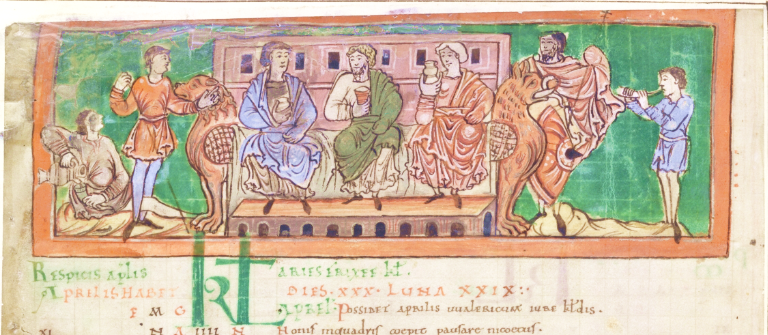
Steward pouring drinks, Cotton MS Tiberius B V, f. 4v, British Library

Fish was an important staple on the Anglo-Saxon table, especially on Wednesdays, Fridays, and Saturdays, feast days, Lent and most of Advent. Inland folk would have to purchase salted, pickled, or smoked fish which could last for months. Shell fish was very popular, like oysters, cockles, eel, crab, and lobster.

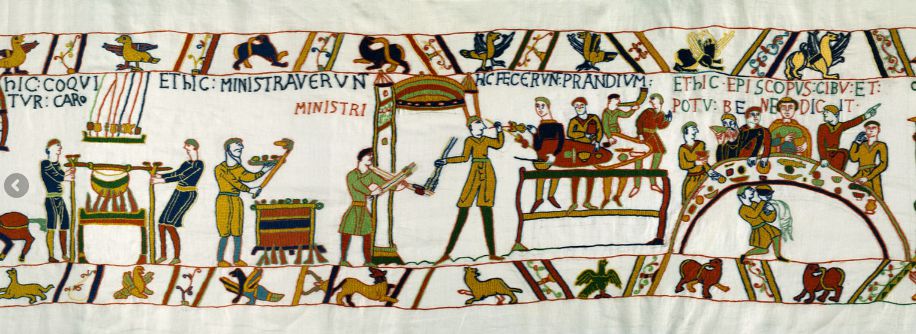
The Anglo-Saxon feast would have seemed quite boring to later medievalists. All the food was served at once on wooden platters. Guests were expected to bring their own knives, spoons, wooden bowls, and drinking vessels. The roasted meats would be placed on platters before the guests, and stews would be spooned into their bowls. Cheeses, breads, and fruits would be served in bowls or platters. The local bard would provide songs and story-telling—an important part of the feast. Meanwhile, mead and ale would be consumed in great quantities, and cider in the autumn. Most everything was dependent on the season, and autumn provided the greatest abundance of choices.

Henry V and his brothers – Part 2

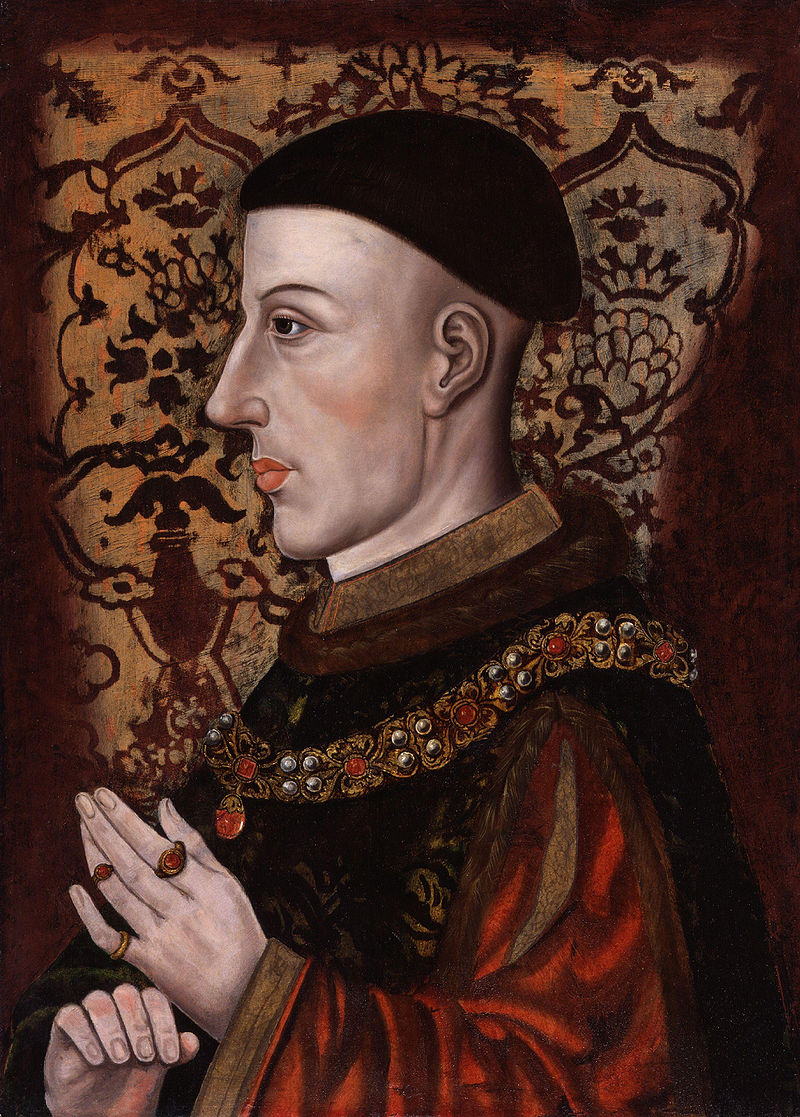
Henry V, from Nat’l Portrait Gallery, London (Wikipedia)

Henry V was fortunate in that he had three brothers to assist him—especially considering he spent most of his reign in France. His relationship with his next brother Thomas, Duke of Clarence, was a bit rocky, but he had to put his personal feelings aside. After all, Thomas was his heir. Once Henry became king, they put their youthful hostilities behind them and Thomas proved to be a strong and forceful leader of men—albeit a little rash at times. When we take a closer look, we see that Henry seems to have wanted to keep him under his direct control; for instance, rarely was Clarence given the opportunity to be regent in the king’s absence (like his other two brothers).

At Harfleur, Clarence led a contingent to the other side of the town from the king; he distinguished himself at the siege to Henry’s satisfaction. In fact, when it came to the time for Harfleur to surrender, they sent representatives to Clarence rather than Henry, hoping to get better treatment. Afterwards, however, when deciding whether to return to England or continue overland to Calais, he argued so aggressively against Henry that the king sent him home. It was said that Clarence was incapacitated by dysentery, but many historians think this was a cover for him to save face, since he went to Calais instead of England. Obviously he wasn’t at Agincourt! When Henry returned to France in 1417, Clarence was prominent in many of the king’s operations, but it was always under the king’s orders.

Thomas was finally given sole command in France the year Henry went back to England with his bride. Finally, he would have the chance to make a name for himself! Unfortunately, at Baugé, he imprudently led an undermanned attack against a Franco-Scottish army, not bothering to wait for his archers. The battle was a crushing defeat that ended in his own death—and advertised to the French that the English were not unbeatable. Henry cut short his progress in England and returned to France so he could reverse the damage done. Did he mourn his brother?  There doesn’t seem to be much evidence of this.

John, the next in line, has come down to us as very capable, solid, steadfast, a good warrior and a great leader. On Henry V’s ascension, John was created Duke of Bedford, the name he has been known to posterity. His eleven-year stint as Warden of the East Marches of Scotland gave him solid training to take over as regent when Henry went on his Agincourt campaign, and again in 1417. In late 1416, John was put in command of a fleet to take provisions to Harfleur, already under siege by a combined Franco-Genoese navy. Attacking the besiegers, Bedford fought for seven hours against the formidable Genoese carracks which towered over the English ships. Ultimately, the English were victorious and decisively lifted the siege, and the conflict, known as the Battle of the Seine, once again demonstrated their vaunted invincibility (this was before Baugé).

Humphrey, the youngest brother, was made Duke of Gloucester at Henry’s coronation. He was still unproven at the time of the Agincourt campaign, so he pretty much operated under the watchful eye of the king. He was eager to prove himself and showed quite a knack for managing the artillery, and Henry gave him plenty of opportunity to hone his skills as commander. Although he was seriously injured at the Battle of Agincourt, the king straddled his prone body and defended him until he was dragged to safety. This was to be the only pitched battle Humphrey ever fought in, but he otherwise proved himself a clever and able commander during the subsequent sieges while the king strived to conquer Normandy. On Henry’s last campaign, Bedford fought in France and Gloucester served as regent in England, so he must have demonstrated enough competence to be trusted.

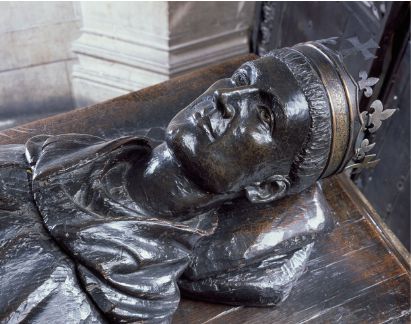
Tomb of Henry V at Westminster Abbey

When Henry died in 1422, he appointed Bedford as regent of France and also of England—when he was there. Gloucester’s role was  more ambiguous. He was assigned as protector of the baby Henry VI, but the child’s upbringing and education were given to Thomas Beaufort, Duke of Exeter (and Henry’s half-uncle).  Gloucester insisted that he should be governor of the realm by right of his birth and his interpretation of Henry’s will. However, the lords in Parliament had other ideas and he had to be satisfied with Protector and Defender of the realm and head of the Council. Humphrey was already demonstrating unsettling tendencies toward self-aggrandisement which would later prove his downfall.

There’s a whole lot more to this story, needless to say, and I intend to devote a whole book to this…probably two novels from now.  More research is required!

Swegn Godwineson, Evil or Tragic?

Matthew Paris, Chronica Majora, II, fol. 52r (56r) – Wikipedia

Swegn was the eldest son of a prolific family. His father, Godwine of Wessex, worked his way up from relative obscurity to the most powerful Earl in the country. Swegn’s future could have been assured if only he had behaved himself and not acted like a rogue and an outlaw. He was the only one of his brood who seemed totally evil from the first. What happened?

We know very little aside from the basic events which look very bad indeed. Initially Swegn held an important earldom which included Herefordshire, Gloucestershire, Oxfordshire, and Somerset. In 1046, as he was returning from a successful expedition into Wales, he is said to have abducted the abbess of Leominster, had his way with her then sent her back in disgrace. For this deed he was exiled and lost his earldom.

Swegn eventually submitted to the King and asked to be restored his lands. At first Edward agreed, but his brother Harold and cousin Beorn, who were given parts of Swegn’s divided earldom, refused to turn over their possessions. King Edward decided to accept their refusal and gave Swegn four days safe conduct back to his ships, anchored at Bosham.

At the same time, England was threatened by a Danish fleet; there was a lot of back and forth as Godwine and sons moved their ships to defend the Kentish coast. Threatened by severe weather, Godwine anchored off Pevensey and Beorn apparently searched him out there (to defend his actions?). Swegn did as well, and I assume there was some heated discussion before Beorn agreed to accompany his cousin back to the king and make amends. Reluctant to leave his own ships unsupervised any longer, Swegn persuaded Beorn to return to his home base at Bosham, from whence they would continue to King Edward at Sandwich.

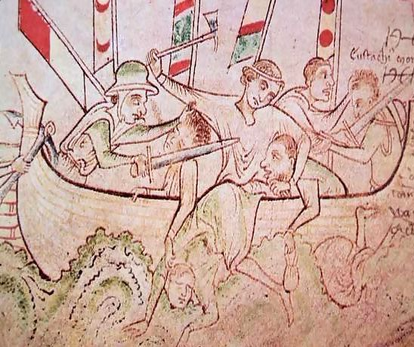
Poor Beorn never made it to Sandwich. Once at Bosham, he was allegedly seized, bound, and thrown into a ship, where he was murdered by Swegn and his body dumped off at Dartmouth. Or possibly, Beorn and Swegn quarreled before the killing, which undoubtedly happened no matter what the cause. This time, Swegn had gone too far. Declared nithing (or worthless) by king and countrymen, Swegn was deserted by his own men and took refuge in Flanders.

King Edward enthroned from Bayeux Tapestry. Source: Wikipedia

Amazingly, the next year he was reinstated in his old earldom with the help of Bishop Ealdred, known as the peacemaker. But trouble was on the horizon (nothing to do with Swegn this time). In 1051 Eustace of Bologne created a huge ruckus in Dover then fled to the king complaining that he lost 21 men to the vicious townspeople. Taking advantage of the opportunity to assert himself, King Edward ordered Godwine to punish the offenders. The earl refused, putting himself on the wrong side of the law. The crisis escalated into an armed confrontation, with Godwine and Swegn cast as rebels. But no one wanted civil war, so Godwine backed down and was eventually driven into exile along with his family. Swegn accompanied his father to Flanders once again, but, overcome with remorse, continued to Jerusalem on a pilgrimage from which he never returned.

It’s easy to dismiss Swegn as the black sheep of the family. But perhaps his story goes a little deeper than that. First of all, consider the circumstances of Godwine and Gytha’s marriage. King Canute gave Godwine—a commoner—in marriage to this high-ranking Danish woman whose brother had recently been killed by Canute’s orders. This doesn’t sound like an auspicious beginning, and I wonder if the early years of their marriage weren’t a bit tempestuous. Perhaps their first son was born in the midst of bitter recriminations? This might explain Godwine’s stubborn defense of his wayward son in face of almost universal disapproval. It was reported that during his second banishment, Swegn put it about that King Canute was his real father, which caused Gytha to strenuously and very publicly object. What was the motivation behind this outrage?

The abbess of Leominster story has a possible explanation. There is circumstantial evidence Eadgifu may have been related to the late Earl Hakon, nephew of King Canute. She may possibly have been childhood friends with Swegn, and perhaps more; it doesn’t make sense for him to have kidnapped a high-profile total stranger. The Worcester tradition states that he kept her for one year and wanted to marry her, but was forbidden by the church and commanded to return her to Leominster, which caused him to leave the country.

As for Beorn, there seems little defense. It has been said that it was Harold rather than Beorn that stubbornly refused to release the territory to Swegn, and this is why Swegn was able to persuade Beorn to accompany him to the king in Sandwich. Perhaps Beorn wanted to please Godwine, his uncle-by-marriage, and agreed to negotiate. Regardless, Beorn must have been the victim of Swegn’s bad temper (at best) or revenge (at worst). Swegn’s decision to go on pilgrimage seems to have been the last attempt to redeem himself.

It is said that Swegn died on his way back from Jerusalem exactly fourteen days after Godwine’s successful return to England.  By all reports, Swegn was mourned by no one except his father. No one was to know it yet, but this was the beginning of the end for Earl Godwine; he fell into decline and didn’t last out the year.

You can read more about this in my novel, GODWINE KINGMAKER.


Review: Agincourt: Henry V, the Man-at-Arms & the Archer

This book is a very solid overview of not only the battle but events leading up to it, from the beginning of Henry V’s reign, the coup attempt at Southampton, the siege of Harfleur, and the long detour the army had to make to find a crossing of the Somme. It’s not until about halfway through that we get to the battle. I’m not complaining, mind you. You can’t tell the story without the background. It’s just that I found the book description a little misleading, as was (in my opinion) the statement on the back cover that we see the battle “through the eyes of key participants”. I’m very deep into my research by now, and I bought this book hoping I would get some really specific stuff, about individual archers, some of Henry’s captains, etc. I should have known better. Agincourt has been gone over meticulously; there’s only so much stuff that’s ever going to come to the surface unless some researcher gets really lucky. With that said, this is a very good book for anyone getting started on their research. The narrative is solid and we get some good historical background. For instance:

His (Henry V) deep piety has been much remarked on and his knowledge of Biblical precedent had featured in the campaign before, such as when he suggested to the townsfolk of Harfleur that he would use the powers allocated by God to a king chastising his subjects as outlined in the Book of Deuteronomy. The whole expedition has been given the impression of something approaching a Crusade by the king, as an act sanctioned and approved by God.

Henry V and his motivations were reasonably discussed, though I really didn’t get the impression I was seeing the battle through his eyes or anyone else’s. But that didn’t matter too much; I came away with a substantial understanding about how the army dealt with their hardships along the way, and even got a good overview of the French side. I thought the Harfleur siege was explained in good detail as well. Unfortunately for me, there wasn’t anything I hadn’t already read before, which made sense once I looked at the bibliography; all the sources used were secondary works. Regardless, the book was interesting, well written, and flowed very smoothly.