Tostig, Earl of Northumbria

Tostig fighting Harold in front of Edward, Cambridge University Library MS. Ee.iii.59

When Siward, Earl of Northumbria died in 1055, his only surviving son was still a child, and King Edward awarded the earldom to Harold’s inexperienced brother Tostig.  Although the King was no fan of of the late Earl Godwine, there is evidence that Godwine’s third son was a favorite at court.  Since he was half Danish, Tostig didn’t seem like a bad choice for the region inhabited by Norsemen, and he served as Earl of Northumbria for ten years before he had serious trouble.

Although he was accused of being overzealous in enforcing law and order, tempers did not rise to the boiling point until he imposed a new substantial tax burden – possibly to help pay for the Welsh campaign he had just waged with Harold in 1063.  Suddenly, all the Northumbrian thegns united against him.  On October 3, 1065, while Tostig was hunting with the King, the rebels descended on York and raided the treasury, killing two housecarls and more than 200 officials.  They declared Tostig outlaw and sent for Morcar, younger son of Aelfgar  who represented the most powerful rival of Godwine’s family (Morcar’s elder brother Edwin was already Earl of Mercia).  Then they sent to the King to confirm their decision and rampaged their way south, gaining support along the way.

Harold Godwineson was chosen to mediate, and met the rebels at Northampton; he had the backing of the King and of Tostig, who had every reason to believe that he would get his earldom back one way or the other.  Alas, Harold was in a big predicament.  He soon learned that Tostig had lost all support in Northumbria; in fact, the only way the Northumbrians could be compelled to accept Tostig back was by force.

Still plundering the area around Northampton, the rebels sent Harold back to the King along with their own envoys, demanding the election of Morcar and outlawry of Tostig.  Harold reluctantly complied, and advised the King against using military force.   Everyone was shocked, and an irate Tostig accused Harold of complicity.


Although Edward initially sought to raise the fyrd against the northerners, his subjects had a horror of civil war – especially for a lost cause – and the King met so much resistance he was soon obliged to accept the rebels’ terms.  He reluctantly sent Harold back with orders to depose Tostig and elect Morcar, pardoning the thegns and reinstituting the laws of Canute.

Swearing vengeance, Tostig went into voluntary exile and Edward’s health slipped into decline the following month, possibly in grief and shock at his loss of authority.  The natural allegiance of Harold and Tostig was broken forever, and the next time they were to meet would be on the battlefield.
 

Aelfgar, Earl of Mercia

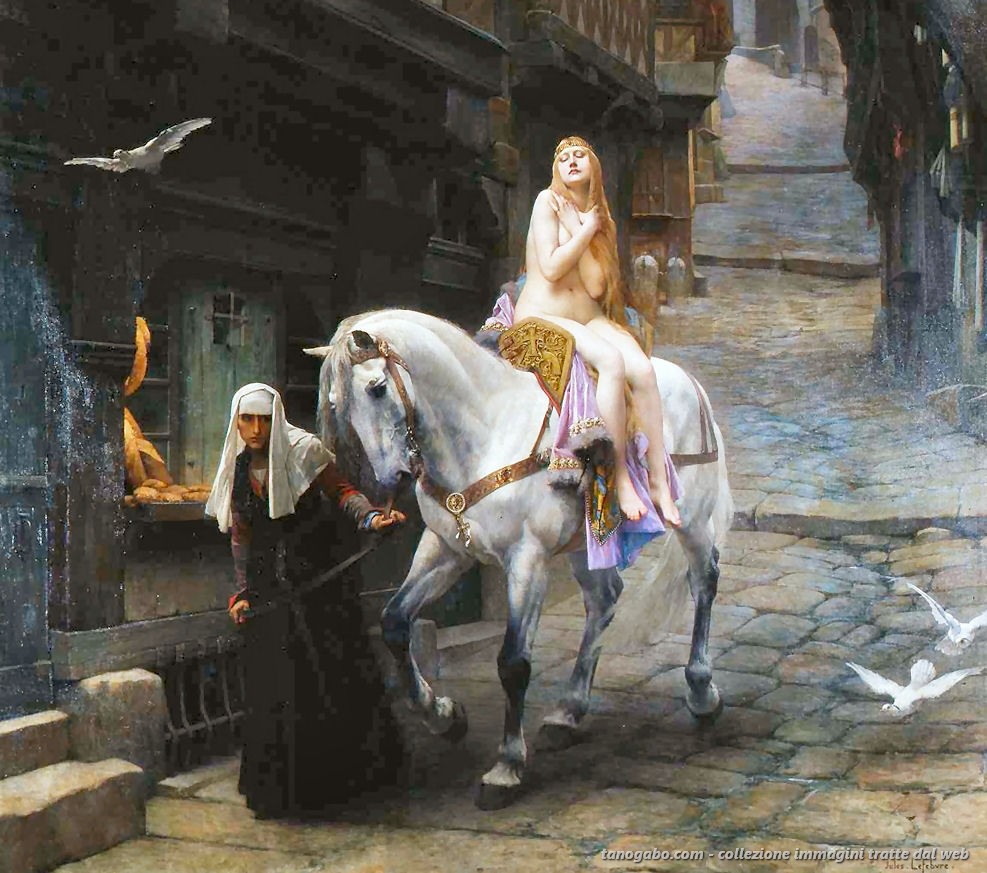
Lady Godiva by Jules Joseph Lefèbvre Source: Wikipedia

Remember Lady Godiva, who is legendary for riding around town naked on a horse, long hair covering her body, to protest her husband’s high taxes? Well, she was not a myth, and was known as the mother of Aelfgar, Earl of Mercia.  His father was the great Leofric of Mercia, powerful Earl and counter-balance to Godwine’s influence.

Aelfgar had an illustrious heritage, although he is remembered more for his troublemaking than for any great deeds he might have done.  He was contemporary with Harold Godwineson, and much of his life, Aelfgar was frustrated by the apparent favoritism shown to Godwine’s brood at his expense.

His first opportunity arose when Godwine and family were exiled in 1051 and he was given Harold’s earldom of East Anglia.  This only lasted a year or so, because upon Godwine’s successful return, Harold was restored to his old earldom.  No mention is made of Aelfgar’s reaction to this demotion, and indeed he received East Anglia again in 1053 when Godwine died and Harold moved up to the earldom of Wessex, leaving an opening which Aelfgar promptly filled.

All was well until 1055, when Siward Earl of Northumbria died.  Because Siward’s only surviving son was still a child, King Edward awarded the earldom to Harold’s inexperienced brother Tostig.  It appears that Aelfgar thought that he was next in line to Northumbria and vociferously contested this appointment, because in the same council he was declared traitor and sent into exile.

This was a big setback, but Aelfgar had earl Harold’s example to follow: in 1051 when Godwine and family were outlawed, Harold had made his way to Ireland and enlisted the aid of the Irish king, who willingly lent  him several ships of mercenaries with which to raid the coast of England.  In 1055 Aelfgar did the same, and returned with 18 ships.  More importantly, he joined forces with Gruffydd ap Llewelyn, Prince of Wales – a mutually beneficial partnership that came in handy every time there was trouble on the borders.

City of Hereford in flames 1055, image by Enok Sweetland

Aelfgar is said to have used his mercenaries to help the Welsh prince eliminate his rival to the South and make Gruffydd ap Llewellyn King of all Wales.  They then turned their attention to Herefordshire and defeated a Saxon force led by Earl Ralph, nephew to King Edward (allegedly the first—unsuccessful—attempted use of cavalry on English soil). Hereford was sacked and even the Bishop was killed while trying to defend his church. This direct attack on English soil prompted Edward to send Harold Godwineson to Hereford so he could deal with the recalcitrant Aelfgar.  After an aborted foray over the Welsh border, Harold opted to negotiate, and offered to give Aelfgar back his earldom, provided that Aelfgar accept Tostig’s appointment.  The Earl of East Anglia jumped at the chance, and for the moment peace was achieved.

In 1057 Earl Leofric died and the earldom of Mercia passed to Aelfgar; East Anglia was given to yet another of Godwine’s sons.  It is said at Aelfgar was beginning to feel threatened by the power of Godwine’s family, and decided to protect himself by giving his daughter Ealdgyth to Gruffydd ap Llewelyn.  This alliance was considered treason, and King Edward banished Aelfgar a second time, who immediately took refuge with Gruffydd.

Once again, the same tactics were used, and the mercenary/Welsh harassment prompted yet another negotiated settlement.  Aelfgar got his earldom back, and his alliance with Gruffydd kept the opposing forces at bay at least until 1062.  At Christmas this fateful year, Harold made a lightning strike at Gryffudd’s court in Rhuddlan, nearly catching the King of Wales at his palace and forcing him to flee by sea. Gryffydd got away but Harold burned his palace to the ground.


It is thought that Aelfgar must have died just days before this raid.  There’s a good chance that Harold heard the news at Christmas court and decided to strike at once before Gryffydd knew of his ally’s death.  None of this is certain…but it follows!  Plagued by the sons of Godwine for his whole life, wouldn’t it be ironic that Aelfgar’s plans would be foiled even after his death. You can read more about Aelfgar in THE SONS OF GODWINE.

Edmund Ironside, Hero or fool?

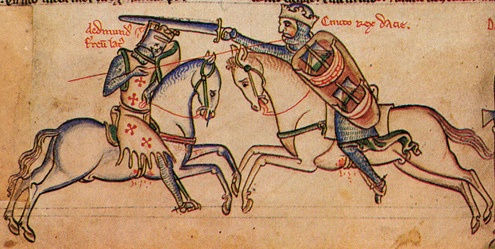
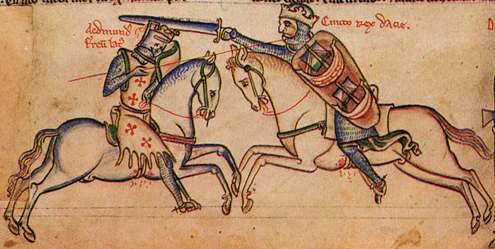
Combat between Canute the Dane and Edmund Ironside, Matthew Paris, Chronica Maiora, Cambridge, Corpus Chrisit, 26, f. 160

Edmund Ironside’s foray into written history was as dynamic as it was brief. 1016 was a pivotal year for England, as we see the death of two kings and an awful lot of Danish activity. By the time King Aethelred the Unready died in April of that year, Canute was entrenched in Wessex, with London as his aim. Edmund was declared Aethelred’s successor and immediately set about to bring Wessex back to fold, so to speak. He was generally successful in both finding men willing to fight for him, and giving Canute a run for his money.

Things might have gone very well for Edmund except for his uncanny adhesion to the infamous Eadric of Mercia, or Eadric Streona, also known as Eadric the Grasper and the most rascally traitor in Anglo-Saxon history. Eadric was famous for changing sides at the most critical moment, usually with dire consequences. Why Edmund kept forgiving him and trusting him remains a mystery—unless it’s because Eadric was married to his sister.

In October, the Battle of Assandun was the turning point. Up to that time, Edmund had won a couple of bloody battles against Canute, but at Assandun, Eadric is said to have cut off the head of a man who looked like the king and held it up, throwing the army into confusion and turning the battle against the English. Most historians believe that Eadric was in the pay of Canute at this time.

Edmund Ironside was soon on the run, and the Danes followed him up the Bristol channel into the Severn, where both sides paused at Olney Island. Legend has it that Eadric, once again at the side of King Edmund, suggested that both chieftains resolve their dispute by single combat. Edmund, by far the larger and more powerful man, agreed as did Canute, who could not afford to lose face.

We can only assume that Eadric managed to secretly communicate his plan to Canute, as its result bore the hallmark of the wily man’s tactics. For, as one would have expected, King Edmund was the stronger fighter and soon hammered the Dane, breaking his shield and beating him down when Canute called a stop to the fight.  “Bravest of youths,” he cried out, “why should either of us risk his life for the sake of a crown?”  Edmund paused, considering.  “Let us be brothers by adoption,” the Dane continued, “and divide the kingdom, governing so that I may rule your affairs, and you mine.” (this came from Florence of Worcester)

And so it was.  Whether it happened by single combat or not, in the end Edmund Ironside agreed to partition the kingdom between them, with the understanding that one of them would inherit the whole on the other’s death.  No mention was made of Edmund’s heirs (remember Eadgar Aetheling?).  Canute got the Danelaw and Edmund held Wessex.

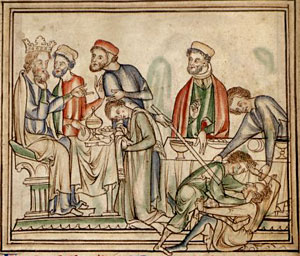
Unfortunately for Edmund Ironside, he did not survive the winter.  Canute had taken up residence in London and the Saxon king died  a couple of months later – some said from exhaustion, or from wounds taken in battle.  But others declared that he was killed by Eadric Streona, who hid in the king’s privy and drove a hot poker through his nether regions (sounds like propaganda). The story goes that Canute, on hearing of Eadric’s despicable murder, ordered his execution on the spot.

Canute was certainly finished with the traitor. Got rid of him, I reckon.


Where did Earl Godwine Live?

These great pre-Conquest Earls, who owned hundreds of estates all over England, must have favored a house or two.  I keep wondering whether a farmer’s field, or a parking lot might be the very site of a lord’s favorite retreat in the country (in the city it would have been better defined).  They had to live somewhere, and since stone castles came later, I guess they must have lived in big wooden structures which of course left no trace.

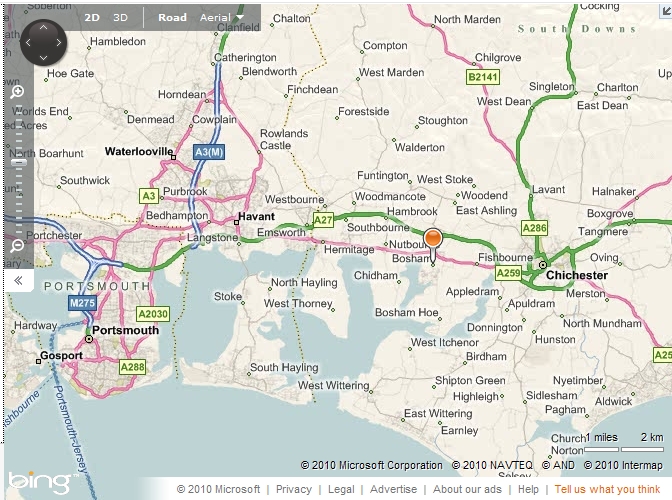
We know that Earl Godwine was probably the richest man in England after the king (or was he richer than the king?).  But where did he live?  Research about Godwine and Harold II keeps bringing up the name of Bosham, which is a town in West Sussex not far from Portsmouth and apparently their mainstay.

It is said that King Canute even had a house in Bosham (after all, he was friendly with Godwine), and that one of his daughters may have drowned in the mill race at Bosham and was buried in the Cathedral.  It is said that Harold Godwineson’s body was buried there (though most people think he was buried at Waltham).  Godwine’s eldest son Swegn murdered his cousin Beorn at Bosham, and Harold is said to have sailed from Bosham on his fateful trip to Normandy, when he fell into the clutches of Duke William.  The Saxon church is depicted in the Bayeux Tapestry.

So there are certainly a lot of associations with Bosham.  I was surprised to find, in A History of the County of Sussex: Volume 4 by L.F. Salzman, that the author was able to trace the Manor of Bosham all the way from the Norman Conquest to the Earl of Iveagh, who owned it when the book was written in 1953. Even William Marshall and clan had a hand in it.

And today, there is still a Manor of Bosham and a Manor of Bosham House, which allegedly stands on the spot of Canute’s residence.  A visit here might be the closest we will get to Godwine’s stomping-grounds, although first you have to get through all the touristy references to Canute Trying to Command the Tide…yep, I forgot to mention that one!

The Battle of Hastings did not take place at Hastings

On my first trip to England I was terribly excited to tour the battlefield of Hastings, and we headed to the town of that name in our rented car.  Mind you, this was in the early ’90s, before the internet and easy access to unlimited information.  I had all my sketches of the battle itself, but I was kind of unclear as to exactly where it was fought.  I figured I’d see signs pointing the way, or something…actually, I’m not sure just what I expected to find!  What I didn’t expect was to find the town of Hastings, and no mention of a battlefield anywhere.  What a panic!

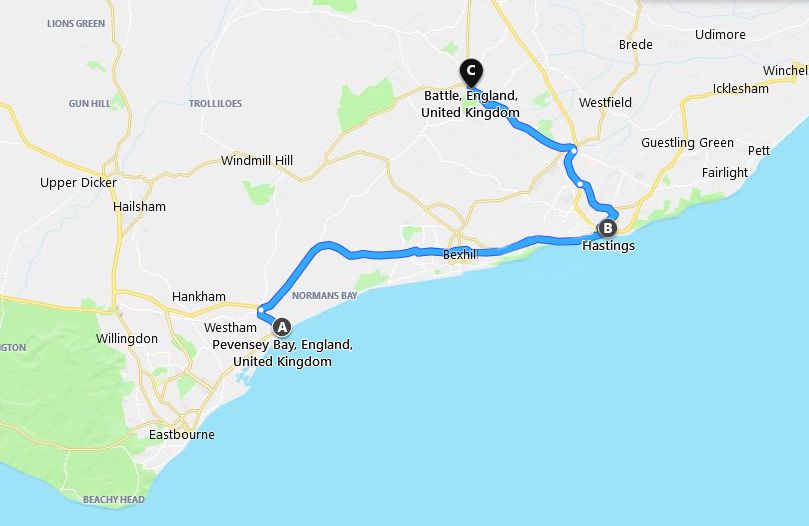
Luckily, Brits and Americans DO share a common language, and a kind soul pointed us in the right direction. We eventually found our way to the town of Battle, a little over 6 miles to the northwest of Hastings.  Needless to say, it’s called Battle for a reason!  There is an abbey ruin on the site, aptly named Battle Abbey, the altar of which was built on the very spot that Harold Godwineson was killed (as per King William’s instructions).  And behind the abbey we found the battlefield, appropriately marked with signboards depicting the stages of the battle.

When Duke William landed his fleet on the shores of Britain, he chose the bay of Pevensey, which was a welcoming haven with an old Roman fort, improved by Harold Godwineson and just recently vacated when the Saxon army marched north to Stamfordbridge. However, Pevensey was surrounded by marshland and could not support the army, so William moved his army east to Hastings. There he erected one of his portable (prefabricated) fortifications near the little harbor. Intending to alarm the Saxons as well as live off the land, he laid waste to southeast England. After a couple of weeks he progressed northward toward London, where he was confronted by the exhausted Saxons in their last stand.

Why is it called the battle of Hastings?  Well, as recently as the 19th century the battle was referred to as the Battle of Senlac; apparently, the venerable historian Edward A. Freeman created quite a controversy by using (or inventing?) this name, which translates to lake of blood. The town of Battle would have been built around the abbey, so it didn’t exist in 1066; Hastings was probably the closest village to the battlefield. Interestingly, no archaeological evidence has been found at the site for any kind of battle, and historians have speculated alternative locations. Even Tony Robbins did a Time Team episode, and concluded that the battle may have been fought right in the middle of the town rather than the traditional field site.

Canute’s London Palace

see www.Archeurope.com

I found it!  After much digging, I found what I was looking for: reference to Canute’s palace in London.  Not only did I find the location, but I stumbled across a juicy tidbit that would fit perfectly into my story.  That’s certainly the advantage of writing historic fiction: a legend is usually more interesting than a dry fact, so why not incorporate it?

It turns out that Alfred’s re-constructed London comprised a very small section on the Thames, from Billingsgate Quay (just downriver from London Bridge), up to the current Blackfriar’s bridge.  There was an old palace between St. Pauls cathedral and the Thames, apparently up against the Roman wall.  Here it is thought that the late Anglo-Saxon kings lived and did their government business.  The location of the palace is the same as the old Baynard’s Castle, which was built on its foundation by a Norman knight.

According to The Gentleman’s magazine, Volume 139, this is the spot where Canute killed the traitor Eadric and had his body thrown out the window of the palace and into the Thames.  Wow! What a scene that must have been!

Where did the King live before the Norman Conquest?

I’m writing this post as I research Anglo-Saxon London.  I’d like to add some historical local color to my narrative, but aside from references to London Bridge and the Roman wall, I’m having a hard time finding mention of anything, anywhere – especially referring to a royal residence. 

The three mile-long Roman walls surrounded what is roughly today’s city limits.  What I didn’t know until yesterday was that after the Romans left Britain, Londinium declined and sat in ruins for about 400 years.  During the dark ages, the Anglo-Saxons established a settlement about one mile west of the Roman walls, called Lundenwic.  The town was at the mouth of the river Fleet (now underground), and served as a lively trading center until Alfred the Great re-established London within its old walls and fortified the city, calling it Lundenburh.  This happened within a 10-year period after 886.  Lundenwic was then pretty much abandoned and called Ealdwic or “old settlement” which evolved into Aldwych, its name today.

All this is very interesting, but it certainly doesn’t answer my question.  However, I have bumped into references that Canute may have built a palace on Thorney Island, the site of the future Westminster Palace (Houses of Parliament).  I’m a little confused, because this site is even further upriver from Aldwych, which was upriver from London Bridge.  But at least it’s a start!  Can’t imagine why Canute and Edward the Confessor would want a palace in a marsh, but I’ll keep digging.

St. Margaret, Widowed Queen of Scotland

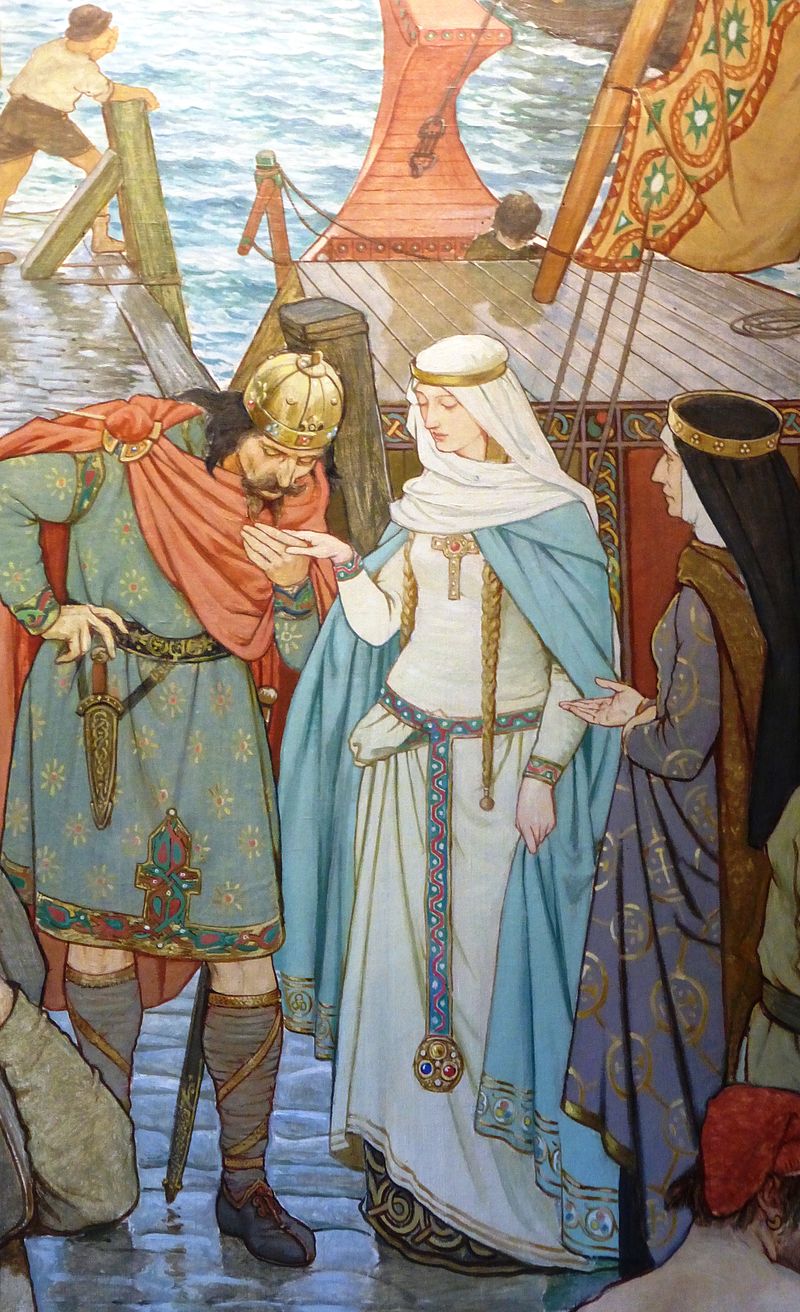
Malcolm and Margaret at Queensferry, detail of a mural by Victorian artist William Hole Wikipedia

In many ways, St. Margaret is a bit of an enigma to us.  Sister of Eadgar Aetheling (see my last post), her family was driven onto the shores of Scotland while fleeing from Norman-occupied England.  She is said to have immediately captivated the King of the Scots, who was determined to make her his wife despite her oft-repeated assertions that she was destined for the church.

Apparently, circumstances pressured Margaret to change her mind about becoming a nun—not the least of which was the obvious need of her brother for foreign support of his claim to the English throne.  But I suspect the main reason she decided to marry Malcolm was the condition of the Scottish Columban church.  They observed the Sabbath on Saturday and worked on Sunday; they refused to receive the Sacrament and didn’t recognize the authority of the Pope. Once Queen of Scotland, Margaret took it upon herself to personally oversee the reformation of the Church, and she did so with ruthless persistence.

A grateful Catholic church remembered her as a perfect, flawless example of Christian piety and duly canonized her in 1250.  What I find interesting is that I believe a canonized female saint must be either a virgin or a widow (please correct me if I am wrong!).  Margaret met that particular condition by a mere three days.  While she lay on her deathbed, husband Malcolm was off on another raid in Northumbria, where he met his end at the siege of Alnwick.

By all indications, their royal marriage was a happy one. Margaret bore six sons and two daughters; the eldest, Edward, was killed alongside his father in 1093. Three of their sons became kings: Edgar, Alexander I, and David I, who reigned until 1153. Their daughter Mary married Eustace III of Boulogne, and Edith (renamed Matilda) married Henry I of England, thus uniting the Normans with the old Anglo-Saxon dynasty.

On receiving news of Malcolm’s death, she is said to have thanked God for “giving her this anguish” at her last hour, then expired, leaving the survivors a difficult task of spiriting away her body while Edinburgh castle was under siege by Malcolm’s half-brother Donald Bane.  (More of that in my novel HEIR TO A PROPHECY.)

Eventually, Malclom and Margaret were buried in Dunfermline Abbey, but she was disturbed again in 1560, when Scottish Calvinist iconoclasts were said to have desecrated the grave and stolen her head.  It is thought that Mary Queen of Scots possessed this reliquary for a while, then the head was toted around Europe and lost during the French Revolution.

Eadgar Aetheling, Ill-fated heir

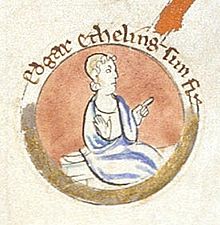
eadgar AethelingEadgar Aetheling was a Saxon prince and grandson of Edmund Ironside, who was briefly king of England in 1016.  He was born in Hungary where his father lived in exile, and in 1057 the family moved back to England at the invitation of the childless Edward the Confessor.  His father, Edward the Exile died a few months later—without ever seeing the king—and the children were raised at court.

When Edward the Confessor died in 1066, Eadgar Aetheling was the only surviving male heir of the royal house, but his youth made him an unacceptable choice for a crown that had so many powerful claimants.  After Harold Godwineson was elected King by the Witan, Eadgar apparently tarried at the court, because after the Battle of Hastings, the surviving Saxon elite rallied around him as the true heir.  They even went so far as to elect him King, but as soon as William of Normandy crossed the Thames, Eadgar’s supporters abandoned their Saxon king and submitted to the Norman conqueror.

Needless to say, William kept Eadgar Aetheling as hostage, but at the first opportunity Eadgar bolted and participated in the first unsuccessful revolt of Northumbria. He was a handy figurehead but knew nothing about leading anyone, much less a force of rebels. After another aborted rebellion, he fled England with his family and embarked for Hungary.  However, a great storm drove their ship into the Firth of Forth, where they landed on the north shore near Queensferry and took refuge with Malcolm III, King of Scotland.

This was a lucky accident for Eadgar, because Malcolm fell in love with his sister Margaret and eventually married her, thus obliging the Scottish King to provide shelter and aid for Eadgar’s future incursions into England.  In 1069, Eadgar was the titular head of a rebellion in Northumbria that achieved early success, and even wrested the city of York from the Normans.  However, William came north with a vengeance and broke up the rebellion, bought off Eadgar’s Danish allies, and drove the Aetheling back to Scotland for protection. This was the beginning of the Harrying of the North, and England’s erstwhile king was nowhere in sight.

Although Eadgar stayed in Scotland until 1072, William eventually forced the issue by invading Scotland and demanding the submission of Malcolm.  Malcolm reluctantly complied, but one of the terms may well have been the expulsion of Eadgar, since the Aetheling crossed over to Flanders.  He was back and forth for a couple of years, bringing trouble in his wake, until Malcolm finally persuaded the Aetheling to make his peace with William and give up any claim to the throne.

Although his tenure in England was anti-clamactic, Eadgar did gain a measure of respect on diplomatic missions between Malcolm and William’s heir, William Rufus.  Many believe that he rescued the children of Malcolm III from the clutches of Donald Bane, who usurped the throne after Malcolm was killed. He later led an army that helped young Eadgar wrest the crown back from Donald in 1097. He befriended Robert Curthose, the Conqueror’s other son, went on Crusade, and lived into the reign of Henry I.  It is thought that he lived until 1125, which would have put him at the ripe old age of 75.


Origin of Earl Godwine

edmundironside_canutethe_dane1
Edmund Ironside and Canute the Dane. CREDIT: Wikimedia

Earl Godwine is one of the delicious mysteries of the eleventh century. Having risen to one of Saxon England’s most powerful positions, as well as father to both a queen and a king, it is a wonder that his origins are so confused.

The most popular story—as written in the Icelandic Knytlinga Saga (written in the 1250s)—is that he was a shepherd, or son of a ceorl, who discovered a Viking Earl wandering lost in the forest after a great battle.  Earl Ulf offered him a gold ring as payment for escort back to his ship, but Godwine decided to forgo the reward and help the Viking as a favor, hoping to earn his fortune in the Earl’s service.  Somewhere along the way he caught the attention of King Canute, who made use of him and eventually raised Godwine up as Earl of Wessex.

Although this story says a lot about Godwine’s abilities, usefulness, or persuasiveness, I can’t help but think it highly unlikely that Canute would notice him at all if he was only the son of a ceorl—much less raise him up to the highest rank in the land after king.

However, there is another explanation that makes more sense.  In some early documents, it is said that Godwine’s father was named Wulfnoth Cild, who was a Thegn in the service of King Aethelred the Unready.  Wulfnoth had command of the Saxon Fleet, and in 1009 he was accused of some unspecified treason. Because of this, Wulfnoth deserted with 20 ships, and resorted to piracy on the Sussex coast.  The king sent his uncle Bithric after him with the rest of the Saxon navy, but the ships foundered in a great storm and Wulfnoth finished them off by burning the fleet.  The destruction of the King’s ships left the way open for that year’s Viking invasion, or, as some suggested, Wulfnoth joined Svein Forkbeard as part of his revenge.

Either way, Wulfnoth was in disgrace.  But could it be possible that King Canute raised up the son in recognition of the father’s aid?  If Wulfnoth was a Thegn, then Godwine’s advancement would seem much less incredible.  No one knows for sure.

Another explanation, less colorful but very sensible, states that Godwine was mentioned in the Aetheling Athelstan’s will (the son of Aethelred the Unready). Aethelstan is said to have granted him his father’s confiscated estate in 1014. On Aethelstan’s death, Godwine is said to have transferred his allegiance to Edmund Ironside, and fought with him against young Canute. He supposedly stayed with Edmund until the end, after which he swore allegiance to Canute along with the rest of Edmund’s supporters. It is said that Canute favored Godwine because he rewarded those who proved loyal to his predecessor.

This latter story promotes Godwine as a warrior rather than a politician, but I tend to favor the former version of the great Earl of Wessex. If you are interested in a further discussion of Godwine’s origins, you can find a long dissertation in the Vol. 1 Appendix of Edward A Freeman’s “History of the Norman Conquest of England”. Or, you can read more in my historical novel GODWINE KINGMAKER.