The Great Harrying of the North, 1069

Harrying of the North by Patrick Nicolle

After the trauma of Stamford Bridge, the northerners were remarkably absent (though expected) at the battle of Hastings.  To say the warriors were exhausted would surely be an understatement, but I wonder, also, if they thought events on the southern coast of England were just too far away to concern them.  After all, the populace was predominately Norse in origin, and many did not even speak a common language with the southerners.

And indeed, after Hastings maybe it seemed like life could go on as before.  William the Conqueror was certainly busy putting down any resistance in the south, and aside from a change in leadership not much happened for two years.  But peace wasn’t meant to be.  York and Durham were just too important to be ignored, and in 1068 Eadgar Aetheling, the last surviving heir to the Saxon crown, made his bid for the throne. He was joined by Edwin, Earl of Mercia, Morcar, former Earl of Northumbria, and Cospatric, current Earl of Northumbria who purchased the earldom from William. King William was quick to respond, and the rebellion was crushed immediately.

Eadgar Aetheling fled to Scotland with his family, and Malcolm III, King of the Scots eventually married his sister Margaret.  Given support from his new brother-in-law, Eadgar returned to England in response to a new Northumbrian uprising in early 1069. In January, Northumbrian rebels converged on Durham, killing William’s new appointee Robert de Comines and all but two of the Normans in the garrison.  Drunk with success, the combined forces continued south and captured York.

There’s a lot of disagreement as to the sequence of events, but ultimately much of York was burned to the ground and the Norman garrison destroyed. Eadgar Aetheling and his supporters joined a large fleet led by the sons of Svein Estrithson, King of Denmark; the Danes were apparently welcomed in the north and became a focus for more revolts in Dorset and Somerset.  Unfortunately for Eadgar, his army was an unruly force and he was more of a figurehead than a leader, so no attempt was made to force his claim or even declare Northumbria’s independence.

King William immediately marched north, causing the Danes to withdraw before him, and made his way to York, devastating the countryside in his path.  By Christmas 1069, he entered the ruined city and celebrated the Nativity in what was left of the cathedral.


What transpired next was on a scale so devastating that even contemporaries, not unused to a scorched earth policy, were shocked.  Deciding to make an example of Yorkshire, William systematically plundered, burned and murdered every living creature between York and Durham. It was said that the bodies of inhabitants lay scattered across the countryside, unburied and rotting, and that starving exiles made their way south, either to die on the road or to sell themselves into slavery for food.  Ten years later, there wasn’t a single inhabited town between York and Durham.

According to Orderic Vitalis, more than 100,000 perished of hunger that year. There were reports of cannibalism, and it was said that William salted the earth to destroy its productivity. This may or may not be true, but even 17 years later, the Domesday book is noted with page after page of the word “waste”, and it is estimated that in 1086 only 25% of the original population lived in Yorkshire.

Eadgar Aetheling fled to refuge in Scotland, and once again the Danes were paid off, just like in the days of Aethelred. King William burnt his way west to Chester before deciding that he had made his point, and spent Easter of 1070 in Winchester, convinced that there would be no more rebellion in Northumbria.  And indeed he was right.  He had bought peace at the cost of much future revenue – not to mention his reputation.
 

What was the Tanist Succession?

The Tanist (or Tannist) is an interesting concept, and not much has been written about it.  In its simplest terms, a Tanist was a royal successor.  Tanistry seems to be Celtic in origin, and appears to have been imported into Scotland from Ireland in the fifth century.  In the earliest days, the Tanist was not necessarily directly related to the king, or even the same branch of the royal family; however they would share a common ancestor.  In fact, during the early middle ages, the King was elected by the noble princely families, and the Tanist was elected as well.  It was a lifetime post.

In theory, the Tanist would have been an ambitious and capable successor, “without blemish”, able to take on the rulership in a time when a chieftain’s life expectancy often did not allow for his sons to achieve manhood.  The Tanist Succession would encourage rotation between branches of a family, and was considered a fair way to keep balance. However, more often than not, it led to dynastic infighting.

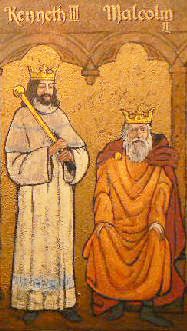
Malcolm II, in 1005, was the first Scottish monarch to introduce hereditary monarchy and female-line succession at the same time, since his heir, Duncan II, was descended from his eldest daughter.  This innovation caused great conflict and he had to spend many years clearing the way to the throne for his grandson.

In fact, Grouch (known as Lady Macbeth) was descended from the rightful King Kenenth III, who was killed by Malcolm II.  Then Grouch’s father, Boede, recognized as the logical Tanist of his branch, was also killed by Malcolm II.  In 1032 Grouch’s first husband Gillecomgain was killed by Malcolm II in an attempt to get rid of her, but she was elsewhere when her husband and 50 men were burnt to death in his fortress.  No wonder Lady Macbeth urged her second husband to kill Duncan!

So the concepts of Tanist Succession and Patrilinear Succession bumped into each other and wreaked havoc for centuries until Tanistry was abolished by James I (James VI of Scotland).  The system lingered in a diminished form in Ireland until the mid-19th century.

Duncan was not killed in his bed by Macbeth

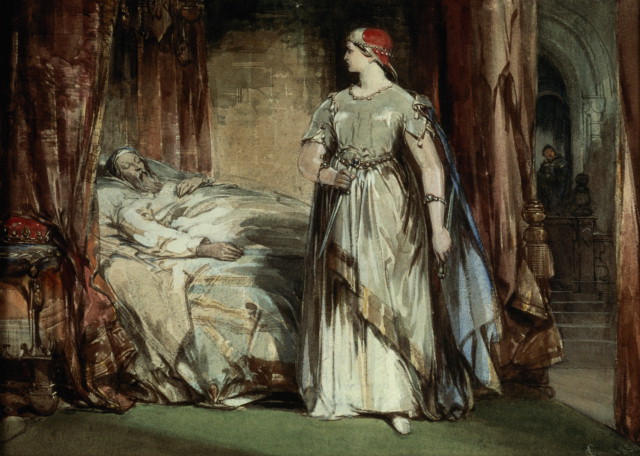
Lady Macbeth and Duncan by George Cattermole; Wikipedia

Shakespeare told some great stories, but historians will agree that real history often gets buried beneath the great Bard’s verses.  The death of King Duncan was one of those exaggerations. For anybody who hasn’t read or seen Macbeth, in essence he meets three witches on the heath who plant the suggestion in his mind that he will be king.  The best way to achieve this is to treacherously kill King Duncan in his bed (as Lady Macbeth goads him on), put the blame elsewhere and seize the throne. Righteous countrymen attack his castle in the end and restore the throne to Duncan’s heir.

Just for the record, when king Malcolm II died in 1034 at age 80, there were many claimants to the throne.  Duncan’s claim was from Malcolm II through his mother’s side (the first of three daughters).  Thorfinn of Orkney,  the great Viking warrior, was Malcolm’s grandson through the third daughter, and was raised under the protection of the King. Malcolm  eventually made him Earl of Caithness (the first time the title of Earl was used in Scotland); this could have been a consolation prize. Macbeth had a claim to the throne through his wife Grouch, who was considered the real heir based on the customary Tanist succession practiced in Scotland; her father’s claim had been put aside by Malcolm II in favor of Duncan.

So  Malcolm II had cleared the way for his favorite grandson, although the 33 year-old Duncan did little to recommend himself to his contemporaries. He fought five wars in five years and lost them all. Ultimately, he made the mistake of trying to claim Caithness which was rightfully ruled by his cousin Thorfinn.  This led to a sea battle where Duncan’s forces were ignominiously thrashed, and the king was forced to flee.

That same year in August, Duncan raised an army including many Irish mercenaries, and met either Thorfinn or Macbeth (or both) in the Battle of Burghead on the Moray Firth. This could be same battle I found reference to, stating that Macbeth killed Duncan at Pitgaveny, which was nearby. It was also recorded elsewhere that Duncan was killed by his own men immediately after the battle. Regardless of who actually killed him, it is clear that Duncan met his end on the battlefield rather than treacherously in bed.  Macbeth was properly elected high king by a council of Scottish leaders, apparently without dissent. In fact, Macbeth ruled for 14 years.  This is a far cry from the grasping, tortured protagonist of Shakespeare’s dark tragedy.

Who was Donald Bane?

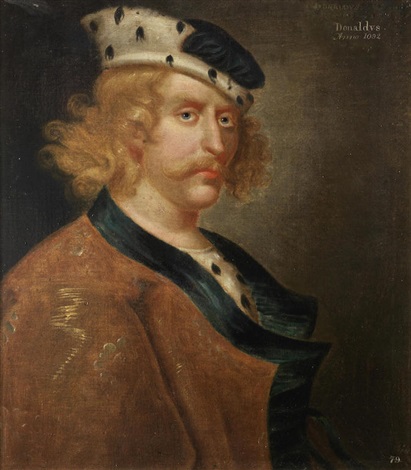
Donald Bane of Scotland, by George Jamieson, Source: Wikipedia

For most of us, our first contact with Donald Bane (or Donalbane) comes with the play Macbeth. After poor King Duncan was killed in his bed, his heirs feared assassination and fled the scene; Prince Malcolm slipped away to England and Donald Bane went to Ireland.  And this is the last we see of Donald Bane in the play. Who was he and what happened to him?

There seems to be no historic trail from the death of his father until 1093, when he usurped the throne of Scotland.  It is said that in 1060 he became Mormaer of Gowrie (modern Perthshire), yet it is assumed he lived in the Western Isles and possibly Ireland.  I’ve found reference to his exile there but no explanation, so we are left to fill in the blanks. What we do know is that he aligned himself with the pro-Gaelic party in Scotland, which was in opposition to Malcolm and Margaret’s attempt to suppress the Celtic Church in favor of Catholicism.

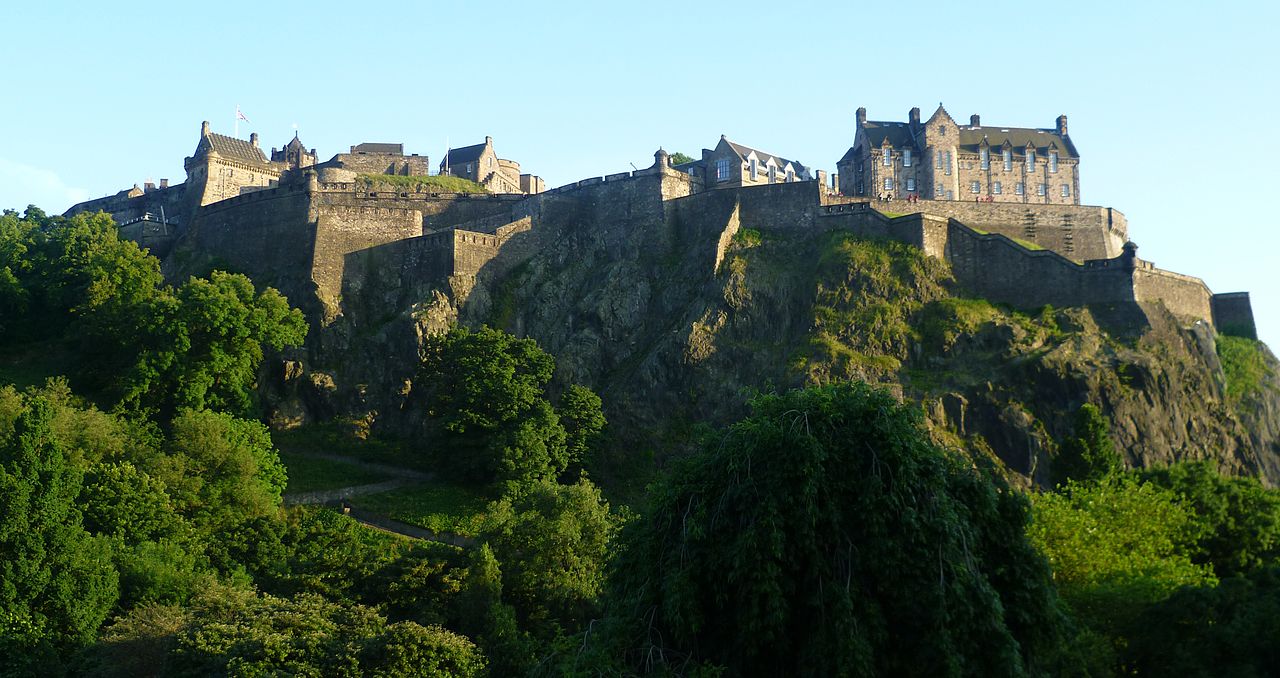
It wasn’t until 1093 that Donald Bane made his move. Somehow he knew about Malcolm’s last campaign into Northumbria, because we find that in the King’s absence he laid siege to Edinburgh castle. He knew that Queen Margaret was in residence with her younger sons, and intended to acquire them as hostages. If you’ve ever been to Edinburgh, you know that the castle is perched high on a rugged cliff, so his army would have encamped on the other side.

source: Wikipedia

Assuming the cliff was impassible was his big mistake. As depicted in my novel, HEIR TO A PROPHECY, the ailing Margaret died within minutes of hearing that the king and her eldest son had been slain. Her surviving sons and servants devised a litter and lowered the queen’s body all the way down the cliff, protected by a mysterious white mist.  They ferried Margaret across the river to Dunfermline so she could get a proper burial.

That didn’t stop Donald Bane. According to the ancient tanist system of Scottish inheritance, the younger brother of a king could inherit the throne before the son if matters were so arranged. Donald was the younger brother of Malcolm III, and was duly elected to the empty throne. However, he only reigned initially for six months, until Malcolm’s first son Duncan (by his wife Ingeborg) invaded with an army backed by King William Rufus of England.

Alas for Duncan, his reign only lasted six months. Donald Bane joined forces with Duncan’s half-brother Edmund (son of Margaret) and killed the hapless king, reigning jointly with Edmund in his stead. Donald oversaw the north (Scotia) and Edmund ruled the south (Lothian).  This lasted for three years.

But William Rufus did not condone an anti-Norman king on the Scottish throne. Edgar, probably the second son of Malcolm and Margaret, had taken refuge in the English court, and Rufus sent him north with an army to dethrone Donald Bane in 1097. The victor was crowned and known as Edgar the Peaceable (because of his submission to William Rufus). Apparently the remorseful Edmund was forgiven and later became a monk, thus removing himself from the succession.

Donald Bane was not so lucky.  Edgar threw him into prison at Rescobie in Angus and had his eyes put out for good measure.  Donald died within two years, and was eventually buried at Iona, the last of  his line to rest with the Celtic kings of Scotland.

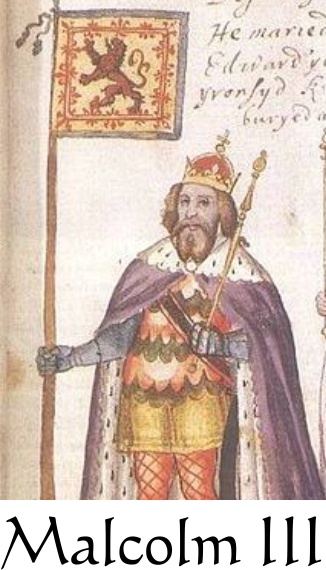
Malcolm Canmore, ancestor of the Plantagenets

I don’t think it would be too much to say that most lovers of the Middle Ages love to read about the Plantagenets.  They all seem to be as colorful as their namesake, Geoffrey of Anjou, who coined the family name from the broom flower planta genista which he tucked onto his helmet (or his hat).  In fact, the Anjou side of the family gets so much attention that very few people give much thought to the fact that Henry II is descended from Malcolm III through his grandmother on his mother’s side.

Malcolm Canmore and Margaret Aetheling had a passel of children: six sons and two daughters.  One of these daughters, Edith (or Eadgyth, later known as Matilda) was married in 1100 to King Henry I of England when she was about 21 years old (thus uniting the Normans with the old Anglo-Saxon dynasty).   This is the same Edith that Malcolm earlier tried to marry to Alain le Roux.  If you saw  the recent series Pillars of the Earth, it’s hard to forget the scene where Henry I keeled over while eating lampreys.  And so he died, according to historians.

If you remember, Henry I had one son who was killed in the White Ship Disaster of 1120, which sunk in the English Channel drowning 300 people.  His only surviving legitimate child was their daughter Maude, who later married Geoffrey of Anjou.  Although Henry I made his nobles swear to support Maude’s claim to the throne, when he died in 1135 she was actually far away in Anjou, leaving the way open for her cousin Stephen to step in and steal the throne.  And spark the civil war, which lasted approximately 18 years.

Maude’s son, the future King Henry II was only two years old at the time.  He did not get to meet his grandmother who died in 1118, but he was knighted by her brother, his great-uncle David I of Scotland in 1149.  He eventually forced David’s son William the Lion to swear fealty to him, but that was after William joined forces with Henry’s three sons and Eleanor in the Revolt of 1173-1174.  But of course, that’s another story!

Alain le Roux, Count of Brittany (Earl of Richmond)

source: Wikipedia

Alain le Roux (c. 1040–1094) is one of my favorite historical characters who seems to have been important in his time, but nobody seems to have heard of him.  Why do I like him so much?  Well, as I see it he went with the flow (so to speak), amassed an incredible fortune (according to Wikipedia, at the time of his death he was worth around $166.9 billion, the equivalent of 7% of England’s national income.  Forbes placed him 9th in the list of most wealthy historical figures) and modestly did his thing, managing to keep King William happy as well as historians.

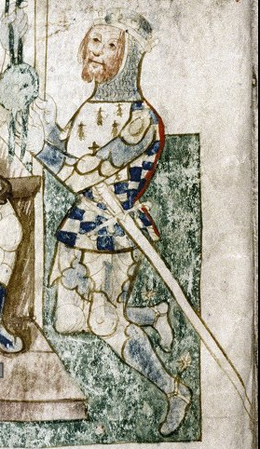
Alain – called le Roux because of his red beard – hits the historical stage around the time of the Norman Conquest.  He was in charge of the Breton contingent, a sizeable part of William’s invasion force.  If you recall, the Breton wing of the Norman army at the Battle of Hastings nearly lost the day: they were the first to panic and flee from the ferocity of the Saxons.  For a moment all was in chaos, then many of the inexperienced Saxon fyrd broke the shield wall and pursued the Bretons.  However, William rallied his men and cut off the Saxons from the rest of the army, wiping them out to a man.  Seeing the success of the maneuver, William instructed the Bretons to do it a couple of times more throughout the battle, with great success.

After William become king he rewarded his supporters with grants of land and titles.  Alain was created the first Earl of Richmond, and a Norman keep stands on the site of his original castle overlooking the River Swale. In 1069, during the great Harrying of the North after the insurrection of Durham, Alain was the man William appointed to do the job.  By the end of his career, he had amassed over 250,000 acres in land grants.  Yet he is said to have died childless and his estate was inherited by his brother Alain le Noir (so-called because of his black beard).

Early in my research for my novel, “Heir to a Prophecy” I unearthed a story that my protagonist Walter actually went to Brittany and married Alain’s daughter, later taking her to Scotland and the court of Malcolm III where he was a favorite.  Although this is probably apocryphal, I did recently find an anecdote that makes me wonder if it could be true.

Just the other day I was reading the book “The House of Godwine: The History of a Dynasty” (by Emma Mason) which was written in 2005.  Four pages from the end, the author states that King Malcolm planned to marry his daughter Edith to Count Alan the Red in 1093 (she was in the Wilton nunnery at the time), and King William Rufus forbade the union, causing Malcolm to storm out of the royal court. Now, why would Malcolm care about Alain unless there was some sort of connection between them (Walter)?

Even more interesting (to me, that is), instead of Malcolm’s daughter, Alain actually took a fancy to another important novice at Wilton: Gunhild, daughter of Harold Godwineson and Edith Swanneck.  At the same time Malcolm took his daughter out of Wilton, Alain removed Gunhild (by then well into her 30s) and brought her to live with him…on the very estates he had taken over from her wealthy mother after Hastings.  When Alain died around 1094, Gunhild stayed and became the partner of Alain’s brother Le Noir, who succeeded to the estates.  What did she have to lose, after all?


Excerpt from “Thou Shalt ‘Get Kings”

This excerpt from my novel is about the Christmas attack made by Harold Godwineson on the Welsh palace of Gruffydd ap Llewelyn in 1062, who was mysteriously warned at the last minute and barely managed to escape by sea:

     Ealdgyth took Walter’s vague warning seriously.  Sensing that they had little time, she hurried back to the feast hall.  She slipped into the room unnoticed, and hurried to her husband.
     Gruffydd was emptying a large goblet when his wife bent over his shoulder.
     “Oh, there you are,” he said, grabbing her around the waist.  “And why did you desert me, without a by-your-leave?”  Smiling, he pulled her onto his lap.
     Ealdgyth allowed the frivolity, because it would bring her closer to his ear.  “My husband,” she whispered, “we are in grave danger.”
     “Eh?”  He pulled back, looking at her face.  “What is it you say?”
     “Tonight I received a warning to leave this place.  I think we should heed a message given by such a source.”
     Gruffydd shook the muddle from his head.  “Stop, woman, with your riddles.  Speak plainly.  Who has given you this warning?”
     “Nesta’s son.”
     “Pah.  The bastard seeks a reward.”
     “Will you stop it?  Can’t you see, he came to save his mother?   He didn’t know she was dead.”
     “So why would he warn us?”
     “I followed him.”  Ealdgyth looked around, half-expecting the doors to burst open.  “For once in your life, give the boy credit.  He is already gone; he wouldn’t take a reward from your hands.”
     “Wife, I think this is foolish, but I can’t afford to take any chances.  Let me up.”
     Sobered by Ealdgyth’s words, Gruffydd stood; the room immediately quieted.
     “The festivities are over,” the Prince announced.  Hearing groans of disappointment, he became angry.  “You will do as I say!   We have been given a warning: there is a threat to our safety this night.  We can either stand and fight, or flee.  But since we are ill prepared to fight, I suggest you leave this place.  We don’t know the extent of the danger.  Gather your families and go.  Now.”
     Motioning for some of his favorites to follow, the Prince gave orders to ready the boats.
     It took very little time to load the boats, always ready docked below the archway of the palace.  Gruffydd didn’t take the strange warning too seriously; though nervous enough to suspect treachery at every turn, he little expected to be attacked during the most sacred holy festival.  But he trusted his wife’s good sense and intuition, which had helped him in the past.  And she was so certain that something was amiss.
     They launched the little vessels, making their way to the mouth of the Clwyd and into the sea.  The cold wind blasted into their faces, and Gruffydd silently agreed with the grumbling of those who regretted leaving the warmth of the feast hall.
     “This is colder than a witch’s teat,” one man mumbled, pulling a blanket around his shoulders.  The boat pitched, nearly throwing him overboard.  “Damn it, man!” he shouted at the rowers.  “Can’t you control this thing any better?”
     “They’re doing the best they can,” the man’s wife retorted. “The poor men are no more sober than you are, never expecting to be dragged away from their drinks in the middle of the night.”
     “Aye, and for what?” someone else shouted over the wind.  “Are we to be startled into flight at the least rumor of trouble?”
     That was enough to get a reaction from Gruffydd.  He turned angrily.  “If I say as much, you will jump into the river on my command!”  He was about to add more but he hesitated, confused.  No one was looking at him; rather, they were staring over his shoulder.  He turned back, following their gaze.
     At first, Gruffydd could only distinguish a reddish glare on the shore – the kind of glow that meant only one thing.  He watched, frozen like the rest of them, while the glare turned into distinct flames.  He listened as the silence of his friends gave way to cries of horror.
     Perhaps, amongst them all, Gruffydd’s mute grief was the most bitter.  He watched his splendid palace burn, and saw the last beacons of violence light the sky from the remainder of his precious fleet.  They were still close enough to hear the screams of his peasants, murdered in their homes.
     Gruffydd sat motionless in the stern of his boat, his mind’s eye seeing Harold pacing disappointedly back and forth before his pillaging troops.  He, Gruffydd ap Llewelyn ap Seisylt, had been outsmarted by this cursed Saxon.  He had barely escaped, thanks to the timely warning from his bastard grandson.
     But the Earl was having his revenge.  The Prince of Wales would never see his beloved Rhuddlan again.

Tostig in Exile

Battle of Fulford from The Life of King Edward the Confessor by Matthew Paris Source: Wikimedia

After the 1065 rebellion that sent Tostig into exile, the Northumbrians apparently felt that the Tostig issue was resolved.  No such luck!  Tostig was busy running around Europe looking for support to re-establish his claim to the earldom.  His first stop was Flanders, where he  brought his family for refuge to the court of his wife’s brother, Count Baldwin V. He was treated honorably in Flanders and spent the winter at St.Omer.

As stated in my last post about Tostig, King Edward died shortly after he was forced to leave the country. This means that Harold was already on the throne when Tostig went to Normandy and paid a visit to William the Conqueror.  I can’t image what he could have offered the Duke aside from a small fleet supplied by his father-in-law, but it does seem like the most onerous insult he could have offered Harold.

In May of 1066, Tostig landed on the Isle of Wight with his little fleet, and I wonder if William encouraged him to cross as a kind of forward movement?  By May, William certainly had been well into his preparations to cross the channel.  Did the Norman Duke try to get rid of him?  Tostig gathered supplies on the Isle of Wight and is said to have forced many of the local seamen to join him with ships. He proceeded to plunder eastward around the coast as far as Sandwich.  This means he would have passed his hometown Bosham; I wonder if he paused to say hello to his mother?

Just after Tostig reached Sandwich, Harold approached with naval and land forces to protect the coast (from Tostig, or from William?).  Tostig withdrew, and moved north to ravage parts of East Anglia; some say he unsuccessfully attempted to draw his brother Gyrth (Earl of East Anglia) into his argument. By the time Tostig reached Lindesey in Northumbria with 60 ships, Earls Eadwine and Morcar – his old rivals – drove him away and Tostig was abandoned by most of his followers.

Reduced to 10 small vessels, Tostig took refuge with his good friend and sworn brother Malcolm Canmore of Scotland.  Always happy to cause trouble on his southern border, Malcolm offered Tostig his protection for the whole summer of 1066.

It’s uncertain whether Tostig went in person to consult with Harald Hardrada. The venerable Edward A. Freeman conjectured that this scenario did not give Tostig enough time to sail to Denmark and try to persuade his cousin Swegn to come and claim Canute’s crown (Swegn is said to have offered Tostig a Danish earldom instead). Nor would he have had the time to sail to Norway.  King Harald wouldn’t have had enough time to raise an army at that late date, so Dr. Freeman felt there was a very good likelihood that Hardrada had planned the invasion on his own many months before, and that he fell in with Tostig after he already made his move. Perhaps they had communicated by messenger while Tostig was in Scotland. I’ve read elsewhere that Tostig visited both Swegn and Hardrada during the winter, which I assume could have been possible if he had taken ship and hugged the coast. Snorri Sturluson gave us a lively account of Tostig persuading Harald to take what is his by right. Regardless, after Hardrada landed in the Orkneys and left his wife there he made his way south and joined Tostig at the mouth of the Tyne.  The stage was set for the battle of Stamfordbridge…almost.

Bosham, home of the Godwine clan

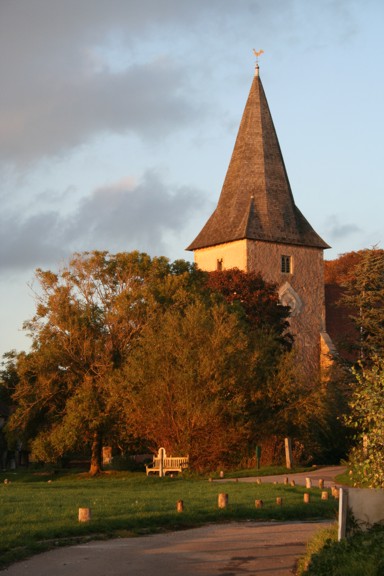
A visit to Bosham reveals a very pretty coastal town with firm connections to the Godwine clan.  In an earlier post, I conjectured that Earl Godwine may have used Bosham as one of his main residences.  It makes sense, since it is one of the only places in England actually drawn in the Bayeux Tapestry; Harold departed from Bosham before his fateful visit to Normandy.

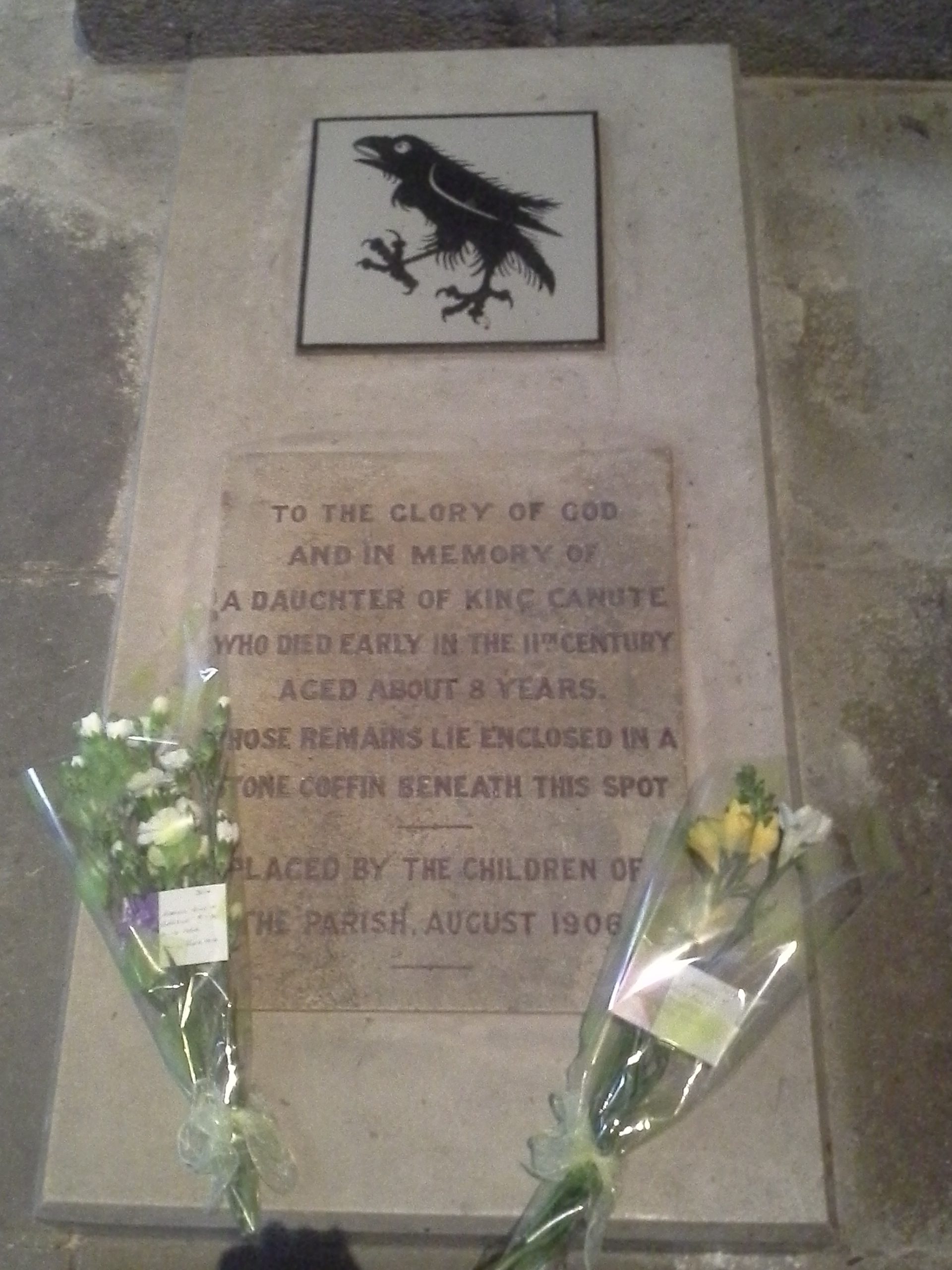
The Holy Trinity church is said to date back to the 10th century on the site of a Roman Basilica, and there is a gravestone under the Anglo-Saxon arch marking the spot believed to hold the bones of an unnamed daughter of Canute who drowned in the millstream. There is no proof that the child’s skeleton belonged to Canute’s daughter, but the position of importance in the church combined with local legends makes a strong case. I find the Canute connection very interesting, since he and Godwine were close throughout Canute’s reign.  It is thought that Canute actually had a residence in Bosham as well, and may have built it on the foundations of Emperor Vespasian’s palace; tradition has it that the Romans established an encampment there. Oh, and this is the place where Canute allegedly tried to Command the Tide, to demonstrate to his followers that even the king’s powers were limited compared to the supreme power of God.

Canute’s daughter’s marker

Even more interesting, in 1954 an unmarked coffin was discovered under the floor stones, just a few feet from the royal princess.  Although the skeleton was not intact, they did identify the “thigh and pelvic bones of a powerfully built man of about 5 ft 6 in. in height aged over 60 years with traces of arthritis” (see John Pollock, “Is King Harold II buried in Bosham Church?”). Its proximity to the princess denotes a person of importance, and local tradition has long believed that the bones belonged to Earl Godwine himself.  However, the Anglo-Saxon Chronicle states that Godwine was buried in Winchester, and John Pollock believes that the bones could have belonged to Harold Godwineson. A headless one-legged skeleton would certainly be consistent with the condition of poor Harold after he was hacked to pieces at the Battle of Hastings! Also, it was said that William the Conqueror wanted to make sure that Harold’s resting place would not become a shrine, and he insisted that his conquered foe would be interred somewhere in secret. He even promised to bury him on the seashore, overlooking the land he tried to defend. Hence, the unmarked grave? Godwine’s manor was reportedly the only territory William took possession of in Sussex.

Although I couldn’t find a “Harold Slept  Here” marker, it was clear that Bosham claimed him as one of their own, and were very proud of their heritage.

Canute’s Grave Sites

source: Wikipedia

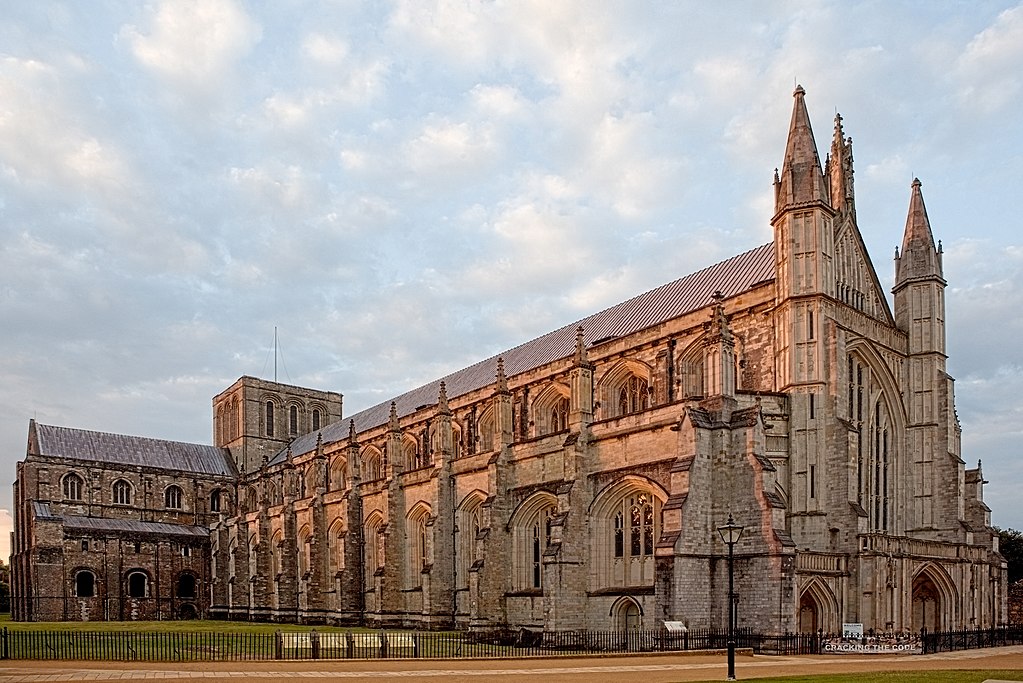
Winchester Cathedral is breathtakingly beautiful and formidable at first sight. Knowing that Canute is said to be buried there, I gazed at the stone foundations of the non-existent Anglo-Saxon Minster with some trepidation. The footprint of the Old Minster butts up against the cathedral, and I wondered what happened to all the bones of saints and kings who resided there before it was demolished in 1093.

Inside, I had to ask three guides before I found one who knew Canute’s name.  “Come, I’ll show you” said a nice elderly gentleman, who was surprised we were American.  Usually only Danish visitors asked about Canute, he said.  I was glad we asked for help; hundreds of people are interred in the cathedral, and he walked us most the way to the back of the building, to the medieval-era chapel whose inside walls only reached three-quarters of the way to the vaulted ceiling.

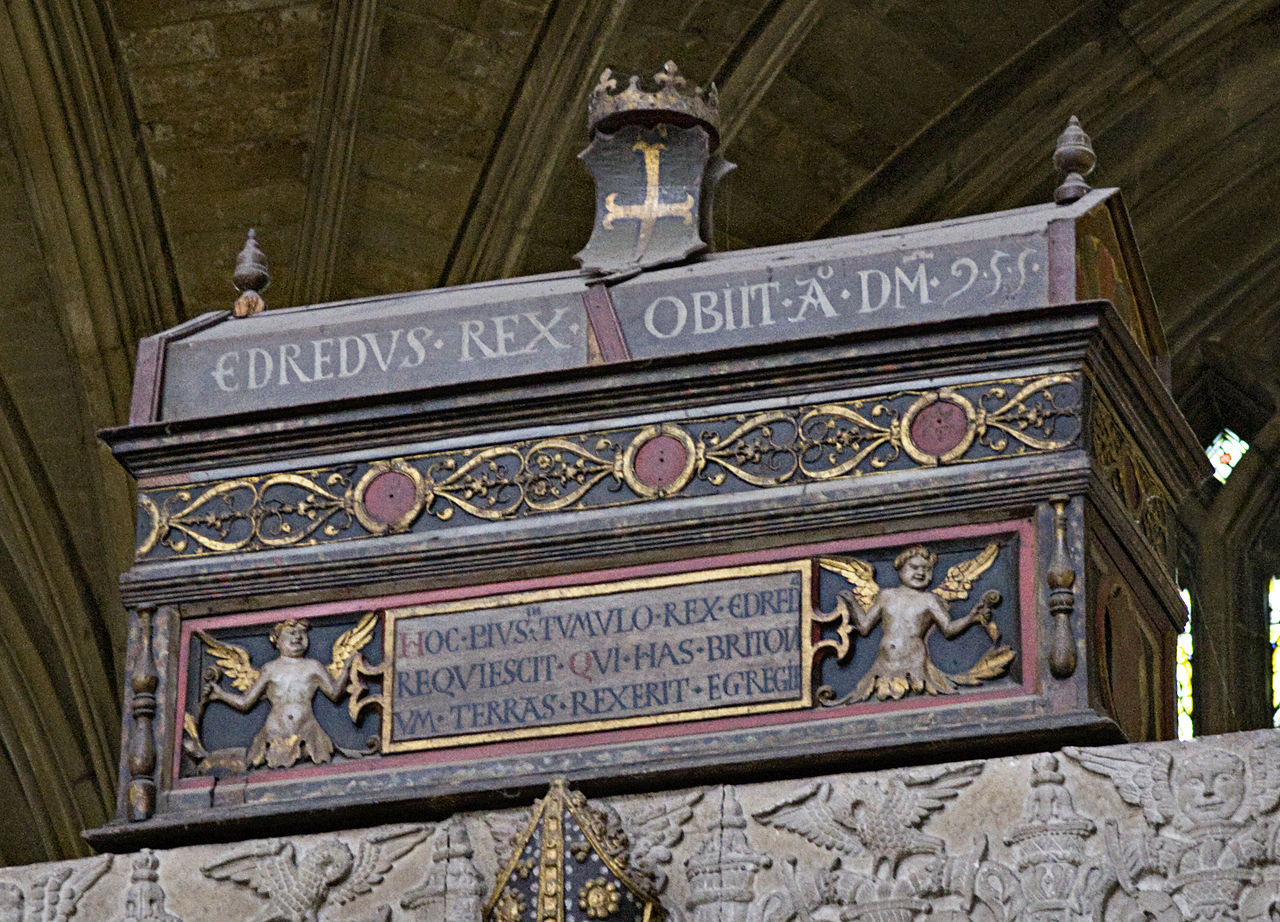
Our guide pointed to a painted wooden chest sitting on a shelf atop the wall, 15 feet above our heads. “He’s there,” the gentlemen said, then pointed to another chest across the chapel, “and he’s there,” he said, then pointed to a third painted chest, “and he’s probably there.”  I just blinked at him, speechless (this rarely happens to me).

Mortuary Chest. Source: Wikipedia

It turns out that during the English civil war, Parliamentary forces vandalized Winchester Cathedral and scattered the ashes of our Anglo-Saxon and Norman kings and bishops all over the floor.  There were originally eight Mortuary Chests, as they are called, and now only six remain.  So the survivors swept up the bones, hopelessly mixed up, and deposited them carefully into the six chests, where Canute keeps company with his wife Emma, son Harthacnut, Bishop Stigand, King Egbert, King Ethelwulf, King William Rufus, and quite a few others going back to the seventh century (even Godwine of Wessex, I trust).

(I keep thinking of someone sweeping up a pile of bones and powder with a broom and a dustpan.)  Anyway, it looks like the chests were actually housed in (now empty) cubicles on the other side of the walls, and perhaps the chests were placed high on the shelves for safekeeping?  Either way, it was certainly not what I was expecting!

That was many years ago. Since then, a team of archaeologists and anthropologists from the University of Bristol were given permission to actually remove the chests and analyze the bones, using DNA evidence and radiocarbon dating. They have yet to determine the identity of the 23 partial skeletons—if that’s ever going to be possible—but they have concluded that the single female skeleton most likely belonged to Queen Emma, wife of Aethelred the Unready and later Canute the Dane.