Sir Simon Burley, Richard’s unfortunate chamberlain

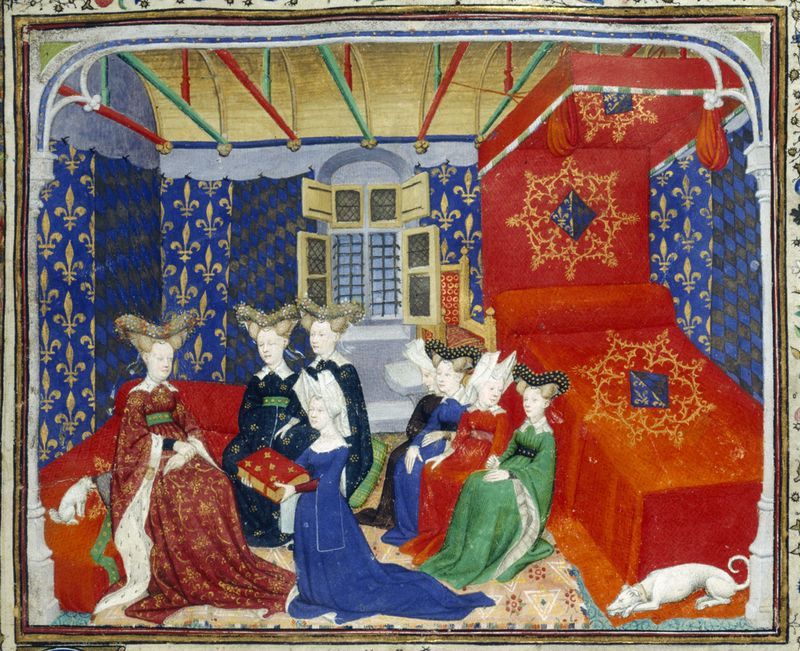
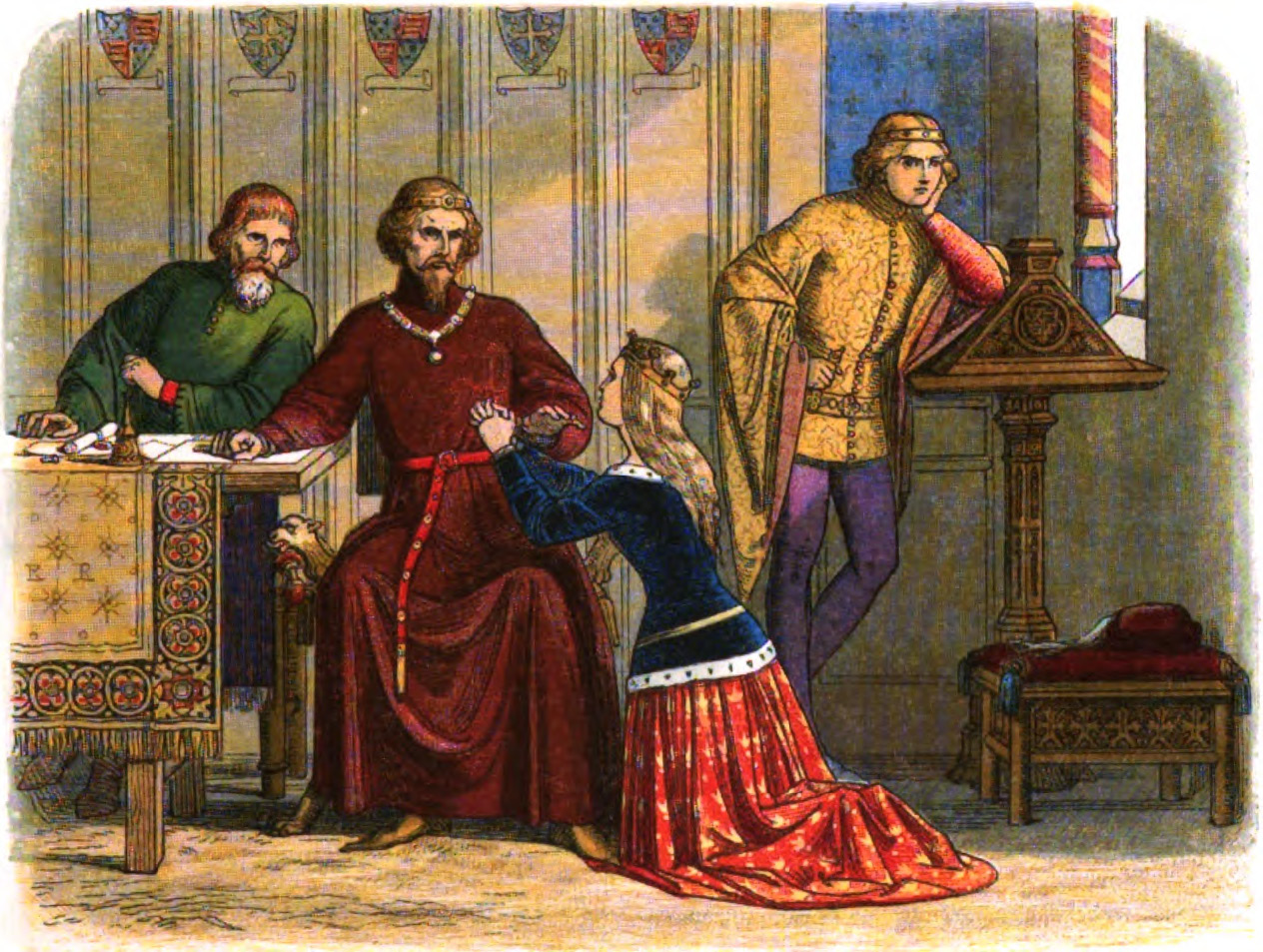
Queen Anne Intercedes for Sir Simon Burley, from A Chronicle of England (Source: Wikimedia)

Sir Simon Burley is one of those unfortunate historical personages who is better remembered for his death than for his life. He is a bit if an enigma to us, if only because he was able to inspire extremes of love, friendship and hate all at the same time. Although he was of humble origin, through his exceptional abilities and loyalty to the royal family, he rose to be Lord Warden of the Cinque Ports, Constable of Dover Castle, and Knight of the Garter. He was also tutor and vice-chamberlain (acting chamberlain) to Richard II, and in this role he inspired so much envy and resentment that he paid for the privilege with his life.

Born around 1336, Simon and his older brother John were brought up in court alongside young Edward (the Black Prince); Simon served Edward throughout the Prince’s life. When Edward returned to England a sick man, Burley became chamberlain of his household and served as tutor to young Richard. In 1377, ten year-old Richard became king; Burley carried the king’s sword at the coronation procession, and after the ceremony he carried the exhausted child on his shoulders—where Richard infamously lost one of his ceremonial slippers. Burley transferred his service to Richard’s chamber and was given the posts of Master of the Falcon and Keeper of the Mews. Then he was appointed constable of Windsor Castle for life and given a residence on Thames Street and grants of land in Gloucester and Kent. In 1384, he was appointed constable of Dover Castle the wardenship of the Cinque Ports. Not bad for an up-and-coming knight!

We first hear grumbling against him during the Peasants’ Revolt. In Rochester, a villein was seized while living in town and imprisoned in the castle. (This was a common imposition on an escaped laborer from the lord’s manor; if he could survive in town for one year without capture, he became a free man.) In this case, the villein was a popular man, and provided the excuse for the peasants to overwhelm the castle and spring him from jail. Simon was blamed for imprisoning the man, even though at the moment he was on the continent; it must have been his servants who created such a ruckus.

And what was Burley doing on the Continent? Nothing less than negotiating the marriage between King Richard and Anne of Bohemia. He missed the Peasants’ Revolt altogether, returning with the bride-to-be in December. By now, just turning 15, Richard wanted to reward his closest adherents but had no resources to distribute. Consulting his lawyers, the King managed to pull some strings and get his hands on the Leybourne inheritance—a considerable endowment willed by Edward III to his favorite religious houses. Through some clever shenanigans, Richard was able to grant Burley several manors, from which he immediately ejected the resident canons and took possession. (Burley wasn’t the only recipient of Edward III’s illegally appropriated endowments.) He was to hang onto his ill-gotten gains until his death in 1388.

As vice-chamberlain, Burley had great influence over Richard. He was accused by some of being the power behind the throne. He controlled access to the King, most certainly advised him; his was a position that easily inspired antagonism. By 1386 there had grown two clear political factions: the court party and what was to become known as the Appellant party, controlled by Richard’s uncle the Duke of Gloucester, the powerful Earl of Arundel, and the Earl of Warwick. Henry Bolingbroke (future  Henry IV) and Thomas Mowbray joined the Appellants later.

Although Simon was of the court party, he wasn’t immediately challenged. The Lords Appellant had bigger fish to fry. Gathering an army, they confronted the King and appealed (accused) five men of treason. Richard sent his favorite, Robert de Vere to collect a force from Chester and the two armies met at Radcot Bridge. Alas, de Vere was not a soldier and his army was easily overcome, leaving the King isolated and alone. Victorious, the Appellants confronted the King and appealed a second batch of men, Burley among them; they wanted to make sure their palace coup was complete. Richard refused and they threatened his crown—actually, it appears they informally deposed him for three days but couldn’t agree on a successor! Beaten, Richard acquiesced to their demands.
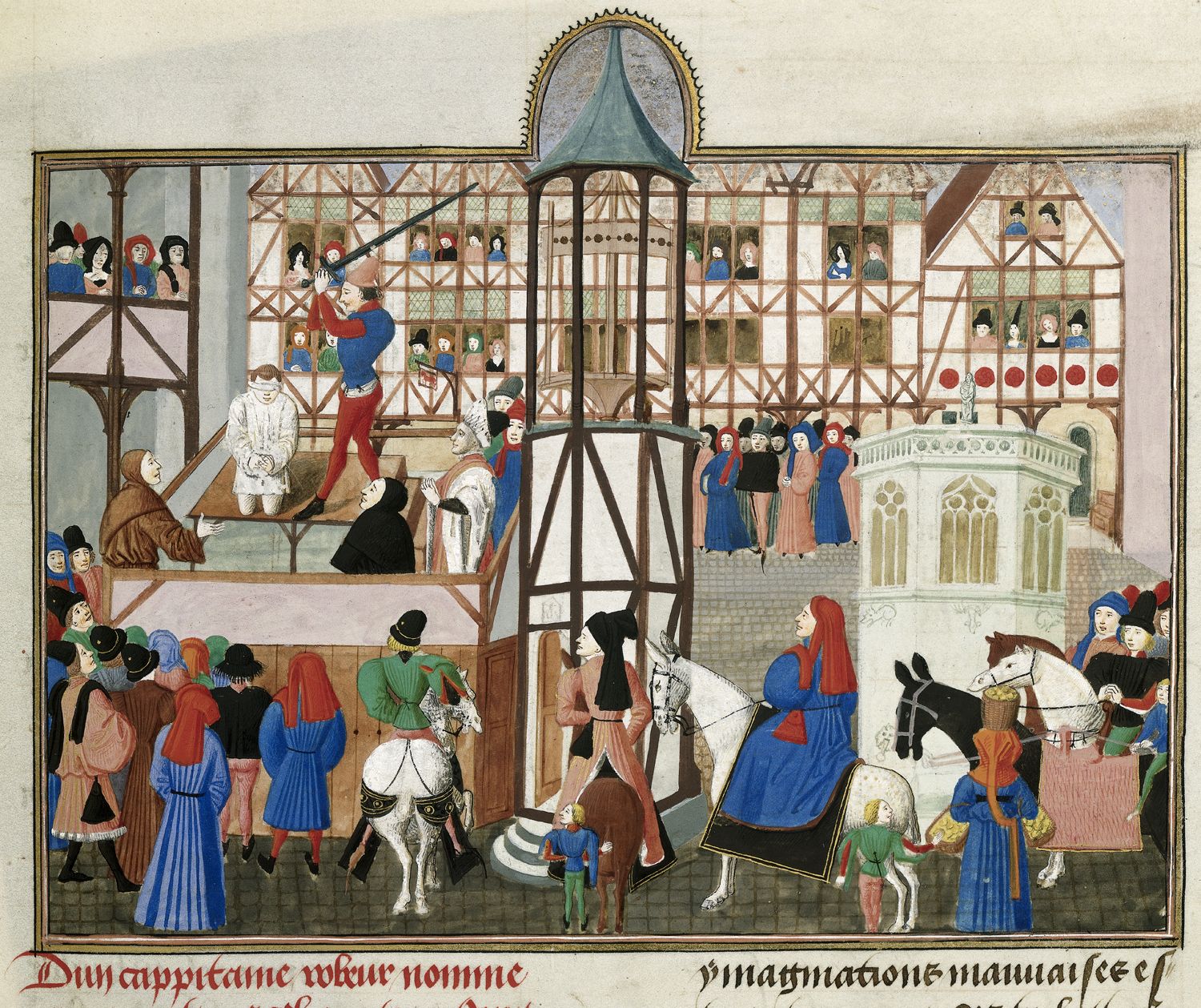
Froissart Execution from BL Harley 4379 f. 64

The Merciless Parliament of 1388 was a nasty affair, and by the time it was over all of Richard’s adherents, from earls to knights, were either killed or outlawed. Burley’s trial was prominent because of the incredible resistance that was raised. He was well respected by many of the magnates who vociferously objected to his treatment. Even the Duke of York created a public row in front of Parliament with his brother Gloucester, threatening him to a duel; their argument was broken up by the King.  Bolingbroke and Mowbray publicly objected to Simon’s sentence. Richard refused to sign the warrant and the wrangling went on for weeks. In a back room, the King and Queen begged for mercy; she even went down on her knees to Gloucester and reportedly stayed there for three hours. It was all to no avail. The Appellants were unrelenting.

The only thing that broke the deadlock was the people of Kent. According to reports, the populace of his own estates marched on London demanding his execution, threatening to start another riot too reminiscent of the Peasants’ Revolt to be ignored. The opposition caved in and Richard reluctantly signed Burley’s death sentence; he insisted that Burley be beheaded instead of the full traitors’ punishment and the Appellants benevolently agreed. What did they care? They got what they wanted. But the King never forgave the Appellants for their brutal and humiliating treatment of him and his friends; in the end, retribution would be his.

Review of A KING UNDER SIEGE by Mary Anne Yarde

“With spades and hoes and ploughs, stand up now.

Your houses they pull down, to fright poor men in town,

The gentry must come down and the poor shall wear the crown…”

It was the age-old question, who should sit on the throne of France? Everyone in England knew that the French crown belonged to the English King — Richard II. Unfortunately, the House of Valois did not agree with the English consensus.

The French were a formidable foe. If the House of Plantagenet wanted to win this war, then they desperately needed to find more money. Parliament was called, and on the request of John of Gaunt, son of Edward III and uncle to the young King Richard II, a tax was agreed upon. Regrettably, this Poll tax was a very regressive tax. An unfair burden that the poor simply could not pay. It was really no surprise when the peasants revolted in 1381.

Richard II was only ten years old when he succeeded to the throne. He was too young to rule on his own. But instead of a regent, it was decided that the government should be placed in the hands of a series of councils, but even then, there were those who thought Gaunt had too much power. But it wasn’t Gaunt who rode out to meet with Wat Tyler (the leader of the rebels) at Smithfield. It was the fourteen-year-old King.

A child Richard may still be, but he was the King of England, and he believed in the royal prerogative. He had also had enough of being told what to do by men he no longer respected. Richard was old enough to know his own mind and to choose his own advisors. However, not everyone was happy with the way the monarchy was heading, and the discontent of those who had been influential rumbled around Richard’s realm like a threatening biblical storm from days gone by. It was only a matter of time before men such as Gloucester and Warwick had their retribution…

From small beginnings to disastrous ends, A King Under Siege: Book One of The Plantagenet Legacy by Mercedes Rochelle is the compelling account of the Peasant Revolt of 1381 and the following turbulent years of Richard II’s early reign.

What an utterly enthralling story A King Under Siege: Book One of The Plantagenet Legacy is. This is the story of a very tempestuous time in English history. Rochelle paints a vivid picture, not only of the peasantry and the hardship they faced but also the corruption and the dangers of court life in the reign of Richard II. These were treacherous times, and Rochelle has demonstrated this with her bold and an exceptionally riveting narrative.

The book is split into three parts, which gave the book a firm grounding of time and place. Part 1 explores the first major challenge in Richard II reign, which was the Peasant Revolt. Rochelle gives a scrupulously balanced account about the revolt. The story explores both sides of the argument, which I thought gave this book a wonderful depth and scope. Part 2 is aptly named “Resistance,” and this section was very compelling as Richard tried to take control of his throne. Part 3, was perhaps the most moving and upsetting as those who thought themselves slighted took revenge upon the King. Rochelle has this tremendous eye for writing very emotional scenes that certainly made me shed a few tears. I thought it was masterfully written.

As I have already touched upon, I thought the portrayal of Richard II was a historical triumph. Richard grows from this unsure youth to a man who is facing a war from those who should be on his side. Forget the war with France, it is the war within parliament that Richard has to try to win.

This story is rich in historical detail. It has so obviously been meticulously researched. I cannot but commend Rochelle for this exceptional work of scholarship.

A King Under Siege: Book One of The Plantagenet Legacy is one of those books that once started is impossible to put down. This book is filled with non-stop action. There are enough plots and conspiracies to satisfy any lover of historical fiction. This is storytelling at its very best.

I Highly Recommend.

Review by Mary Anne Yarde.

The Coffee Pot Book Club.

Richard II and his Queens

BL Harley ms4431-f003r Source: Wikipedia

Like many of us, I first learned about Richard II from Shakespeare. The consummate storyteller, Shakespeare gave us a grown-up queen who threw herself into Richard’s arms as he was led to prison. Imagine my surprise to learn that in reality, Richard’s queen was only ten years old! Ah, and she was his second queen. His first, Anne of Bohemia, had died five years before his deposition and two years before he remarried. How in the world did that happen?

We don’t know very much about Anne of Bohemia. She was of impeccable ancestry, the eldest daughter of the Holy Roman Emperor Charles IV. But the real reason Richard married her was for politics. By then, the Great Schism had occurred and Europe had two popes. Clement VII moved to Avignon, and was supported by the French. Urban VI was in Rome and was supported by England as well as the Holy Roman Empire. After much negotiating, Richard was betrothed to Anne so he could gain the Emperor’s support against their mutual enemies. This was far from a popular match; Anne’s brother, the wily Wenceslaus, had succeeded her father in 1378 and was in financial straits. Not only would Anne come without a dowry, Richard was obliged to loan Wenceslaus £12,000. Many argued against the marriage, but for some reason Richard was adamant.

Anne’s journey to England was perilous. Accompanied by Sir Simon Burley, Richard’s vice-chamberlain and a slew of Bohemian ladies and knights, Anne had to wait on the Calais side of the Channel for a couple of months. She was a prize, and Norman privateers were trolling the waters looking for her—stopping and pillaging every ship they could get their hands on. Finally, her uncle the Duke of Brabant managed to persuade King Charles of France to provide a safe-conduct for her, as she was the King’s distant relative. Once the wind was favorable they crossed to Dover and landed on December 18, 1381—just in time to meet her future husband for Christmas at Leeds Castle.

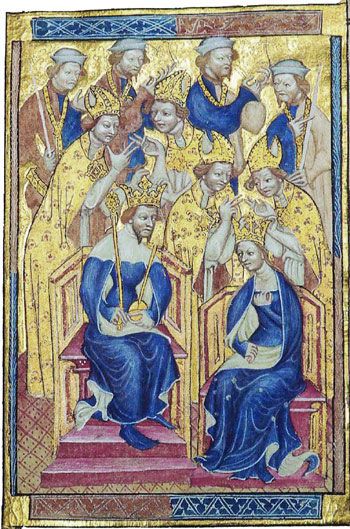
Coronation of Anne of Bohemia with Richard II
Coronation of Anne and Richard from The Liber Regalis, Source: Wikipedia

By all accounts, theirs was a love match from the first. Although she was not considered a great beauty, Anne had a sweet disposition. At age fifteen she was one year older than Richard and their closeness in age (and inexperience) probably contributed to their affection for each other. Unlike most kings of the middle ages, he was not unfaithful to her. She provided him with love and support even during his most troublesome episodes with his overbearing uncles. They were rarely apart during their twelve year marriage. He built a private getaway on a little island in the Thames across from Sheen Palace (same site as Richmond Palace) called Le Neyt—a rarity in times when royalty was almost never alone. Even so, sadly, she never conceived.

Anne is best known for introducing the sidesaddle to England—a strange contraption which consisted of a little bench strapped to the horse with a footrest. Each lady’s palfrey was led by a footman who managed the bridle-rein while the lady held onto a pommel; this meant that they could proceed at no faster than a walk. But this was no matter; the sidesaddle was merely used for ceremonial purposes. The Bohemians also introduced those funny shoes with elongated points called Crakows, or sometimes Poulaines because they were originally from Poland (the extreme version was attached to the knee with a gold chain). They were also the first ladies in England to wear the outrageous headdresses with wires and pasteboard horns extending two feet high and two feet wide and shaped like a wide-spreading mitre, draped with fine glittering veils.

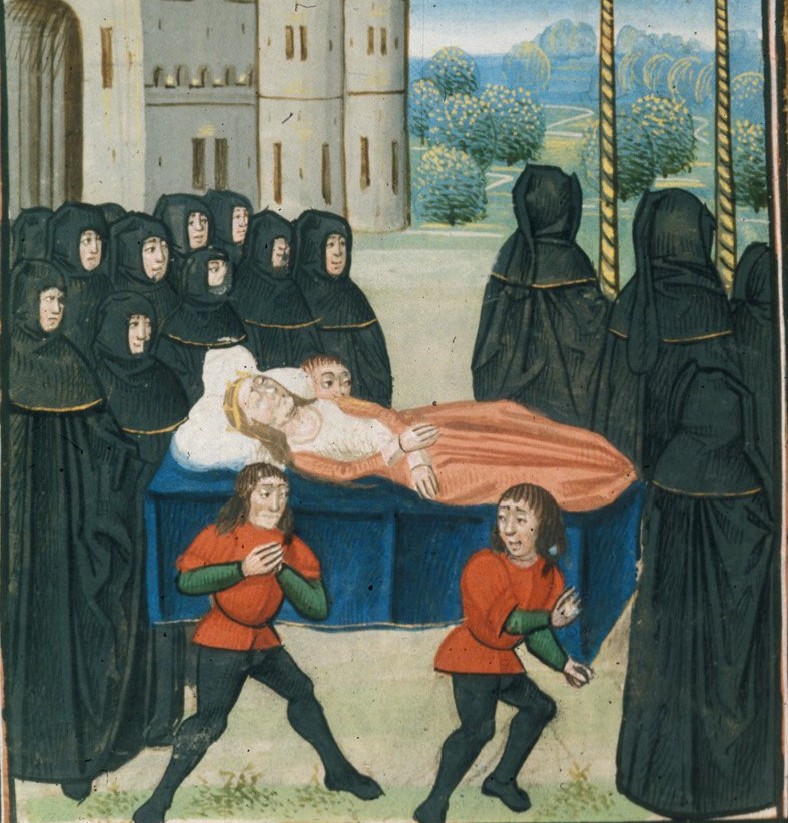
Funeral of Anne of Bohemia
Funeral of Anne of Bohemia. Source, Wikipedia

Queen Anne died suddenly in 1394, possibly from the plague because it all happened so quickly — but this seems unlikely to me since nobody else was ill. Richard was inconsolable and ordered his workmen to destroy Le Neyt (or maybe even the whole palace; no one knows for sure). He swore he wouldn’t enter any building they lived in for a whole year, excepting the churches. Anne was buried at Westminster Abbey and her gilt bronze effigy (alongside Richard) can still be seen.

But a kingdom without an heir left itself open to civil war, as Richard knew all too well. At the same time, for many years he had been leaning toward peace with France, even though many of his militaristic subjects strongly disagreed. Two years after the death of Queen Anne, Richard concluded a 28 year truce with France, and part of this agreement was his offer to marry King Charles’s seven year-old daughter Isabella. Why did he do this? I’m inclined to think that this gave Richard plenty of time to grieve for Anne while accomplishing an alliance that was very important to him. At 29 years of age, he felt that he still had plenty of time to beget an heir.

Meeting of Richard II and Isabella of Valois
Meeting of Richard II and Isabella of Valois, from BL Harley 4380 f.89

A great ceremony was held on a large field at Andres, eight miles south of Calais. Ironically, this was exactly the same site as the Field of the Cloth of Gold attended by Henry VIII and Francis the First 124 years later. It was said that Richard’s pageant was every bit as elaborate and expensive as his successor’s. Interestingly, on opening day Richard’s retinue was dressed in red velvet with heraldic trappings from Queen Anne’s livery. He was determined not to forget her.

Little Isabella came back to England with her handsome new husband and was housed at Windsor Castle. She was crowned at Westminster the following year. Richard doted on his Queen and it was said she adored him, but there was no question that many years would pass before he took on his conjugal duties. As it turned out, of course, he was dead in four years, leaving her a prisoner of the usurper Henry IV; the new King wanted her to marry his son, the future Henry V. But she showed amazing fortitude for someone so young; Isabella refused and went into mourning. A year later Henry allowed her to go back to France but he kept her dowry. When she was sixteen she married her cousin Charles, Duke of Orléans who was only eleven. And yet, three years later she died in childbirth. Poor Isabella never got a break. If they had been given more time and had Richard II managed to sire an heir, it would have been much more difficult for anyone else to usurp the crown. And perhaps the Wars of the Roses would never have occurred.

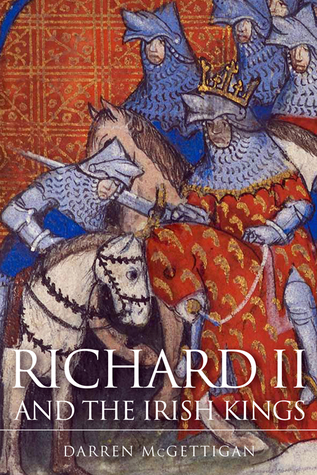
Book Review of RICHARD II AND THE IRISH KINGS by Darren Mcgettigan

This is a book written by an Irish man for the Irish reader. It’s a very interesting angle, because it helps to demonstrate that Richard II’s part of the history is not necessarily at the foremost of everybody’s mind (“In 1397 Roger Mortimer’s uncle, Sir Thomas Mortimer, fell foul of the king in some palace intrigue…”). The contemporary Irish kings are what matter most here, and how they interacted with the intrusive English. This is the best book I’ve found so far that actually gives us a good idea just went on in the Irish campaigns, how Richard caught the famous Art MacMurchadha Caomhanach totally by surprise, and how Art later put his hard-earned lessons to good use. We also see that much of the violence that wracked Ireland after Richard left in 1395 was associated with Roger Mortimer, 4th Earl of March and lord lieutenant of Ireland: “By 1396 Roger Mortimer was at war with many of the Irish kings of north Leinster and south Ulster. The annals record that in that year he attacked the Clann Sheoain… He also attacked the O Raighilligh kingdom of East Breifne, where he cut passes through two forests and killed the noble Mathghamhain O Raighilligh… In early 1396 Mortimer ‘made a treacherous raid on O Neill before launching a larger assault on Tyrone…’” This sounds quite contrary to Richard’s policy of tolerance, justice and good government. Mortimer may well have done more harm than good, and his death precipitated Richard’s second expedition to Ireland in 1399.

Although I found the Irish names difficult to grasp, the author wisely gave us maps that helped locate the chieftains and kingdoms, as well as all the towns and castles, mountains and forests that Richard had to negotiate. I consulted them regularly! As a reference book, if you are researching the Irish campaigns, this book is invaluable. For light reading, you may get bogged down (pardon the pun!) in a hurry.

Shakespeare’s Richard II

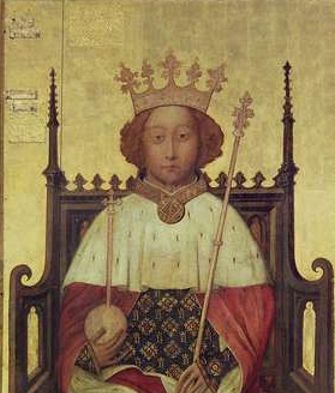
Richard II Westminster portrait
Richard II Westminster portrait. Source: Wikipedia

Like many of us, I first learned of Richard II from Shakespeare. Even though I knew nothing about him, I was totally moved during the prison scene while he bemoaned the fate of kings—and I never recovered! But his story goes way beyond the events of this play; in fact, Shakespeare only covered the last year of Richard’s life. He tells us nothing about what led up to the famous scene between Bolingbroke and Mowbray, where their trial by combat was interrupted and they were sent into exile. This was indeed the crisis that led to the king’s downfall, but Richard’s story is much more complicated than you would ever think from watching the play.

First of all, did you realize that Henry of Bolingbroke was Richard’s first cousin? The clues are all there but it’s not easy to put them together. The old John of Gaunt (“This blessed plot, this earth, this realm, this England…”) was the eldest of Richard’s surviving uncles, and because Richard was childless he was next in line to the throne (debatable, but that’s another story). Bolingbroke, Gaunt’s eldest son, was next after him. This did not appeal to Richard; in fact, according to all reports, having Bolingbroke as his heir was anathema. Why? Events in my book, A KING UNDER SIEGE, will give you a good idea. Richard and Henry were never friendly, but during the second crisis in Richard’s reign, Bolingbroke was one of the Lords Appellant—the five barons who drove the Merciless Parliament to murder the king’s loyal followers.

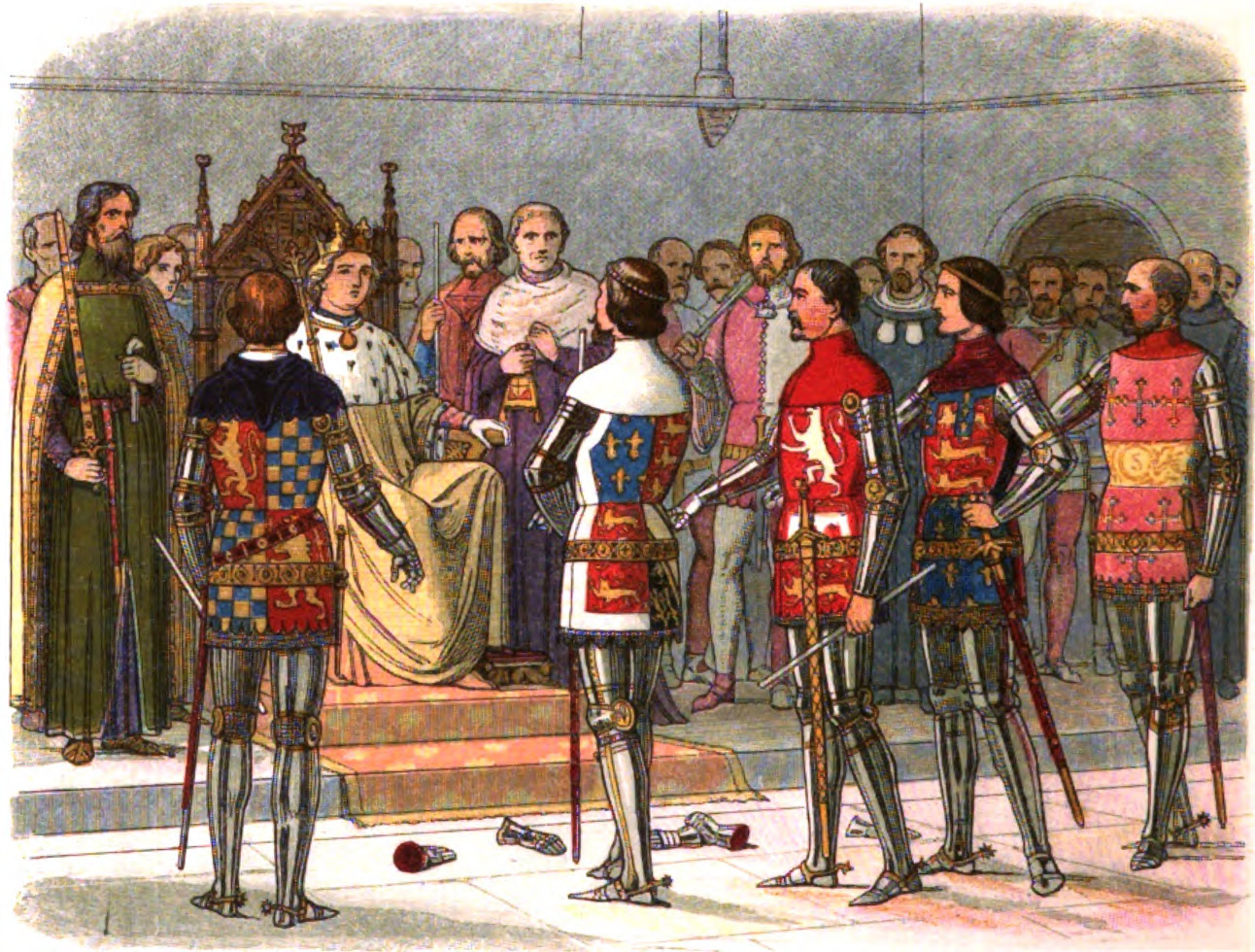
The Lords Appellant before King Richard II
Arundel, Gloucester, Nottingham, Derby, and Warwick, Before the King Source: Wikimedia

Richard’s minority was not easy. The doddering Edward III was hardly a role model, and neither was his father, the ailing Black Prince who languished for years, disabled and debilitated. On Edward III’s death, Parliament insisted on Richard’s coronation instead of a regency; many feared that John of Gaunt would seize the throne. Nonetheless, what could one expect from a ten year-old? Four years later, the boy king proved himself worthy during the Peasants’ Revolt, but his subsequent attempts to assert himself led to conflict with his magnates. His bad temper, sharp tongue, and impetuous nature gave the restive barons plenty of excuses to hold him down. Richard’s solution was to surround himself with cooperative friends and advisors and exclude the self-righteous lords from his inner circle, which infuriated them. The king needed proper guidance, they insisted; his household needed purging.

The Lords Appellant, as they came to be known, threatened Richard with abdication—humiliating him and destroying his power base. At first there were three of them: Richard’s uncle Thomas Duke of Gloucester, Thomas Beauchamp Earl of Warwick, and Richard FitzAlan Earl of Arundel.  After Richard’s aborted attempt to raise an army in defense, Henry of Bolingbroke and Thomas Mowbray joined their ranks—the same who challenged each other in Shakespeare’s play.

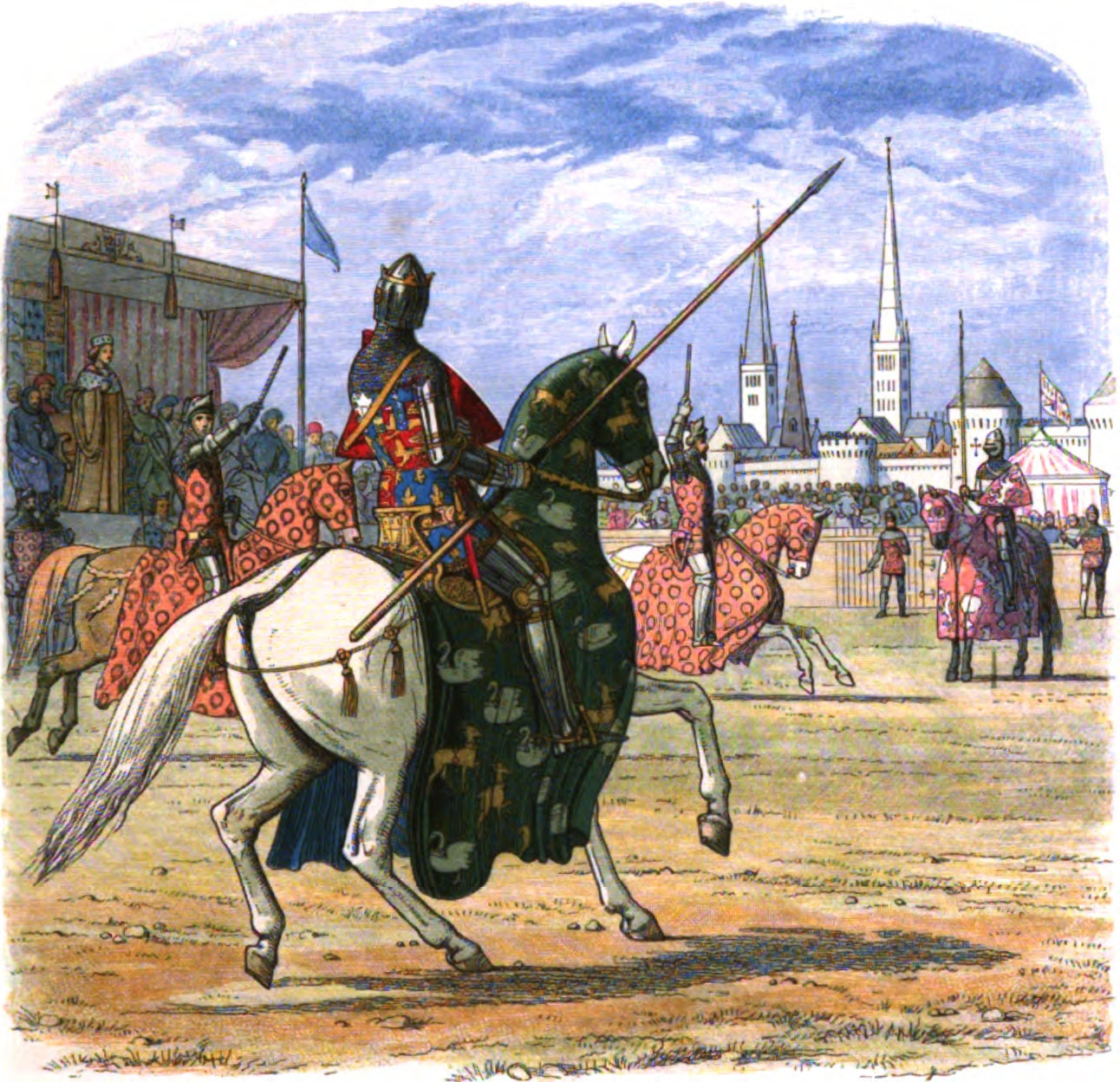
King Richard Stops the Duel Between Henry Bolingbroke and Norfolk
Richard Stops the Duel Between Hereford and Norfolk from “A Chronicle of England” illustrated by James William Edmund Doyle. Source: Wikimedia

So you can see that Shakespeare’s trial by combat had a lot more going on than could easily be explained. Richard may have appeared detached while he observed the quarrel between Bolingbroke and Mowbray, but under his regal bearing he must have been shivering with glee. The altercation between these two knights was actually the result of their involvement in the Merciless Parliament. A year before the play took place, Richard had already succeeded in wreaking revenge on the original three Appellants. Mowbray feared that their turn was next, and when he voiced his concerns to Bolingbroke, the latter tried to save his skin by telling the king. The argument escalated from there, giving Richard the perfect opportunity to get rid of both of them. He made his fatal error when he went too far and deprived Bolingbroke of his inheritance.

Shakespeare gave us the poignancy of Richard’s last days. Historians have left us more of a conundrum which may never be sorted out. Richard’s 22-year reign can be divided into two parts: the 12 years of his minority and the ten years of his majority—each of which are brought to a tragic climax. Hence, it will take two books to cover his story. As you might guess, volume two will be called THE KING’S RETRIBUTION.

New Release: A KING UNDER SIEGE

BOOK BLURB: Richard II found himself under siege not once, but twice in his minority. Crowned king at age ten, he was only fourteen when the Peasants’ Revolt terrorized London. But he proved himself every bit the Plantagenet successor, facing Wat Tyler and the rebels when all seemed lost. Alas, his triumph was short-lived, and for the next ten years he struggled to assert himself against his uncles and increasingly hostile nobles. Just like in the days of his great-grandfather Edward II, vengeful magnates strove to separate him from his friends and advisors, and even threatened to depose him if he refused to do their bidding. The Lords Appellant, as they came to be known, purged the royal household with the help of the Merciless Parliament. They murdered his closest allies, leaving the King alone and defenseless. He would never forget his humiliation at the hands of his subjects. Richard’s inability to protect his adherents would haunt him for the rest of his life, and he vowed that next time, retribution would be his.

Richard II has proved to be one of the most enigmatic kings in the Middle Ages. Just like that other Richard (III, as we know him) his reputation was demolished by the person that usurped him. Historians are destined to muddle through documents that have been altered or written by hostile chroniclers. They must search for missing records and interpret passages written by survivors anxious to curry favor with the new king—or at least escape censure. It doesn’t help that there is such a wide range of conflicting opinions about him.

Like many of us, I first learned about Richard II from Shakespeare. Even though I knew nothing about him, I was totally moved during the prison scene when he bemoaned the fate of kings—and I never recovered! But his story goes way beyond the events of this play; in fact, Shakespeare only covered the last year of Richard’s life. We know nothing about what led up to the famous scene between Bolingbroke and Mowbray, where their trial by combat was interrupted by the king and they were sent into exile. Once I did my research, I was astounded at how complicated Richard’s life really was. His 22-year reign can be divided up into two parts: the 12 years of his minority and the ten years of his majority—each of which are brought to a tragic climax. Hence, it will take me two books to cover his story. As you might guess from the book blurb, volume two will be called THE KING’S RETRIBUTION.

Available on Amazon.com
and Amazon UK and Amazon CA

Richard II and Primogeniture

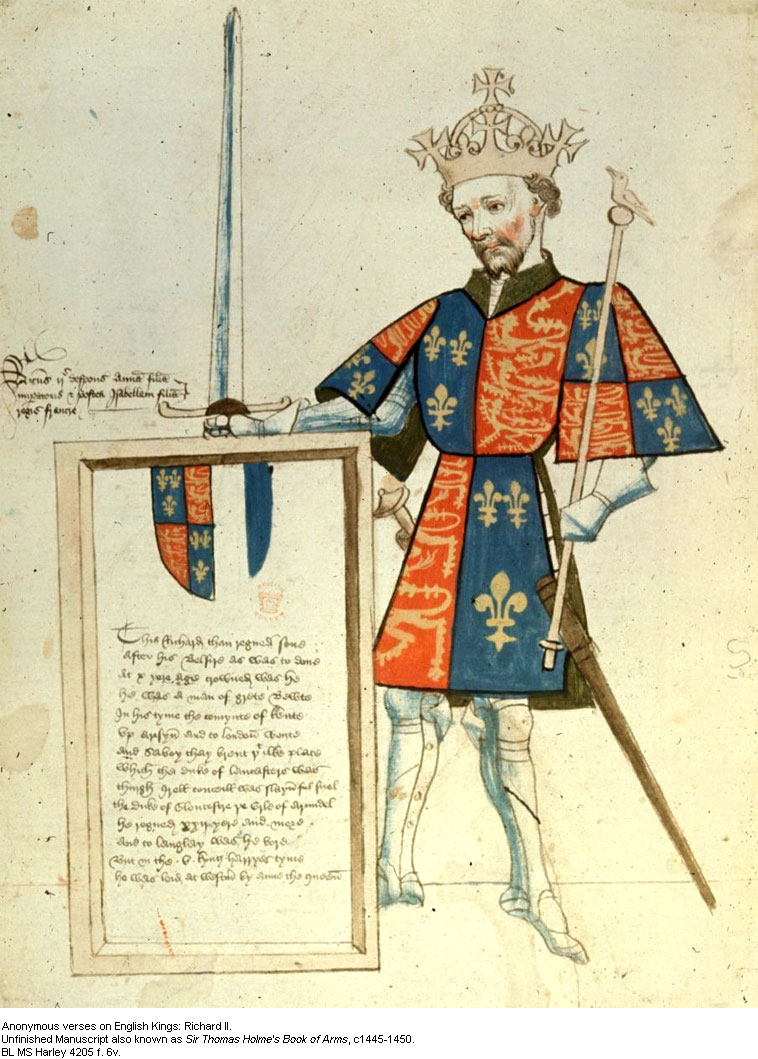
King Richard II and his coat of arms
British Library: MS Harley 4205 f.6V

At first glance, one might not question the law of succession in England during the Middle Ages, but in reality the rules were open to interpretation, which is one reason the Wars of the Roses were fought with such intensity. As far back as King John, we see the youngest brother of a previous king mount the throne rather than the son of an elder brother (Arthur of Brittany—son of Geoffrey—should have ruled if the tradition of primogeniture were followed). Even Edward I, after the death of his three eldest sons, declared an order of succession that included his daughters. When it was Richard II’s turn, the issue was far from settled.

In 1376, Edward the Black Prince was dying. His child Richard, who was himself the second son (the first son Edward had died two years previously), was only nine years old. The Black Prince took nothing for granted, and on his deathbed he asked both his father and his brother John of Gaunt to swear an oath to protect Richard and uphold his inheritance. Even this precaution didn’t guarantee Richard’s patrimony, and Edward III felt obliged to create an entail that ordered the succession along traditional male lines. This meant that the Mortimers, descendants of Gaunt’s deceased elder brother Lionel (through his only daughter Philippa) were excluded. It also meant that John of Gaunt was next in line after Richard, and after him, Henry of Bolingbroke.

By this time, Edward III was an enfeebled old man and Gaunt had already started attending Parliament in his name. At this stage of his life, John of Gaunt was an overbearing, arrogant bully and he was incredibly unpopular. There were great fears—probably unfounded—that he would usurp the throne from his nephew; most historians believe that because of this, Edward III’s entail was not publicized. Presumably only the inner family and the great officers knew about its existence. After all, why inflame the public unnecessarily? If Richard were to sire an heir, the whole entail would be moot.

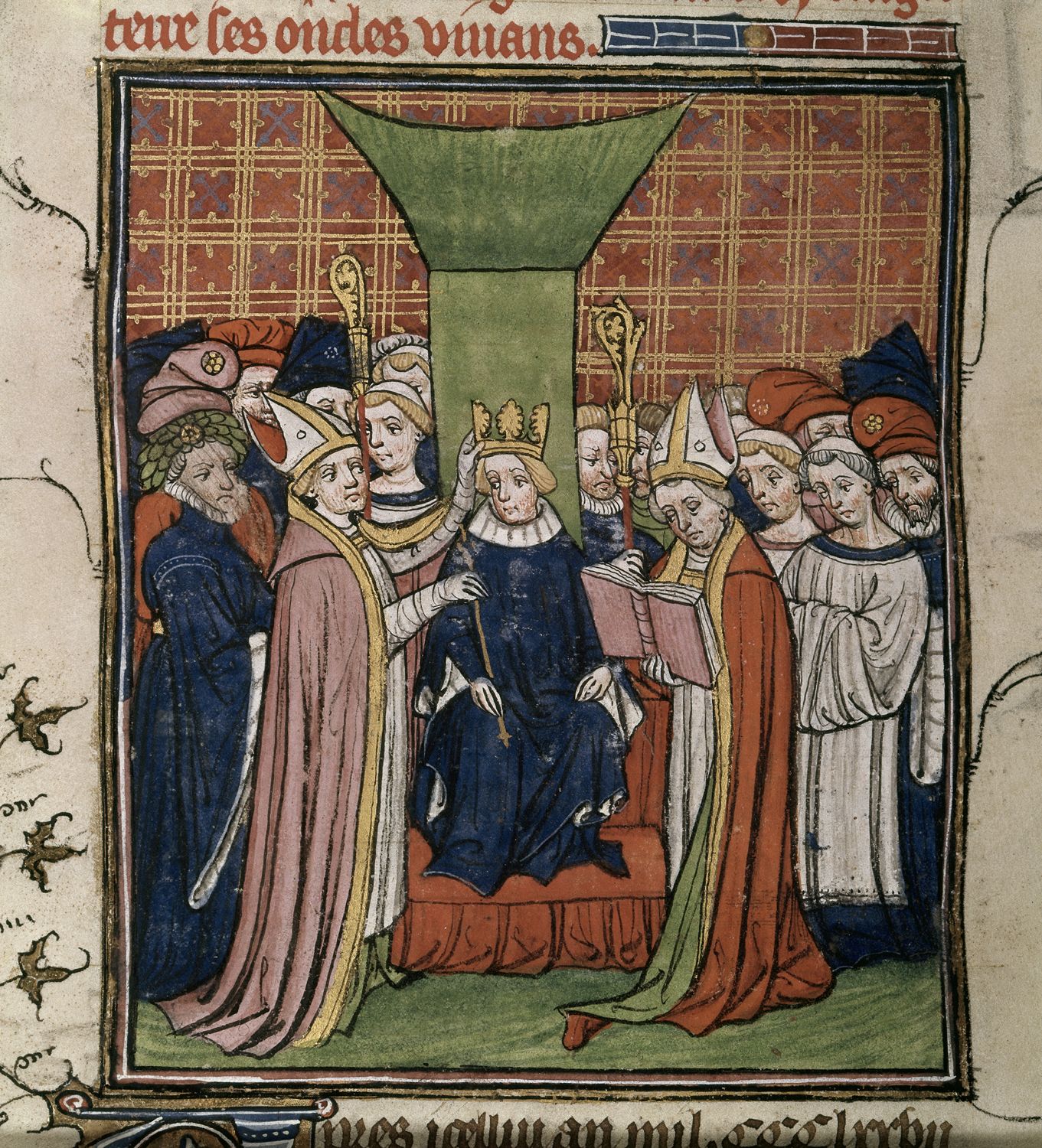
Coronation of Richard II
Coronation-Richard-BL-Royal-20-C-VII-f.-192v

So the ten year-old Richard was crowned king; nobody wanted to take a chance on a less-than-secure regency. But this was not the end of the story. In the short run, of course, there was no reason to give the succession much thought. Richard married at age fifteen and his queen was only a year older than him. But after five or six years of infertility, it was beginning to look like there might be a problem. Queen Anne’s untimely death after twelve years of marriage and Richard’s subsequent espousal to the 8 year-old Isabella of France made it obvious that a child could not be expected for a long time—possibly never.

Many people, including our primary chroniclers of the period, took it for granted that the Mortimers were next in line for the throne. But Richard made no effort to show favor to Roger Mortimer, 4th Earl of March, nor did he make reference him to him as heir except possibly once in 1385 or 1386 (historians are not in agreement on this). When threatened with deposition, Richard could well have declared Roger his successor, a political ploy to remind his opponents that a 12 year-old would not rule any better than him. Although the Earl of March was well liked by the general population, after 1394 he seemed to have lost political clout. He moved to Ireland, where he served as Lieutenant mostly for the rest of his life. Roger was killed in a skirmish in 1398, leaving behind a seven year-old son. This effectively removed the Mortimers as candidates—for the time being—but they were destined to come back and haunt Henry IV in the rebellions of 1403 and 1405. (Also, their bloodline descended to Richard Plantagenet, 3rd Duke of York on his mother’s side.)

But even this wasn’t the end of the story. Richard was antagonistic toward John of Gaunt and this ill-will was transferred to his cousin Henry of Bolingbroke, especially after Henry joined the Lords Appellant and nearly cost him his throne in 1388. After the Appellant crisis, when Gaunt returned from Portugal, Richard received him joyfully back into the country; he had finally discovered that Gaunt’s presence was the only factor that kept his rebellious magnates at bay. In this time frame, by all indications, he restored Edward III’s entail and treated Gaunt as his heir—at least for the next five years.

John of Gaunt att. to Lucas Cornelisz de Kock
John of Gaunt with his coat of arms attributed to Lucas Cornelisz de Kock source: Wikipedia

But this favor did not extend to Bolingbroke. In 1394, as Richard was planning his expedition to Ireland, Gaunt petitioned Parliament to appoint Bolingbroke as Keeper of the realm. The Keeper was traditionally the heir to the throne, so Gaunt was fishing for a commitment. He couldn’t serve as Keeper himself because he was due to leave for the Aquitaine, so naturally Henry—next in line according to the entail—would take his place. However the Earl of March raised a strong objection, for he felt that he was heir apparent (it is possible he did not know about Edward III’s entail). Richard told them both to be silent and instead decided that his uncle Edmund of Langley, Duke of York (Gaunt’s younger brother) would be Keeper in his absence.

This was a whole new turn of events! Suddenly Gaunt was out and Edmund was in. From that point on, relations between Richard and the House of Lancaster began to sour. The King showered favors on his cousin, York’s son Edward, and created him Duke of Aumale. Whether Richard had intended to make York his heir, as Ian Mortimer concluded, remains speculation. If this was the case, it’s puzzling that Edmund defected to Bolingbroke, thus giving up his own—and his son’s—potential claim to the throne. Perhaps he had no inclination to be king; he was thought by many to be an indolent, irresolute fellow. Nonetheless, it was Edmund of Langley who fathered the House of York which proved so formidable in the Wars of the Roses.

Richard found it useful to keep everyone in suspense about the succession and never did proclaim a definite heir, though for the last several years he favored his fair-weather cousin Edward Duke of Aumale. When Bolingbroke invaded England, Aumale eventually went over to his side. That was the end of Edward’s possible aspirations!

After Richard’s usurpation, Henry IV chose to justify his claim—not by force of arms, but by citing his double descent from Henry III (through Edward III on his father’s side and Edmund “Crouchback”—younger son of Henry—on his mother’s side). Nonetheless, the Lancastrian line petered out in two generations, leaving the country ripe for a dynastic struggle—precipitated, many say, by the murder of the last true Plantagenet king.

In the end, could it be said that Richard II was usurped by his natural heir? He certainly wouldn’t have thought so! His reckless decision to disinherit Bolingbroke showed all the characteristics of personal enmity. Many historians think he was only waiting for Gaunt to drop dead before confiscating the Lancastrian inheritance and eliminating Henry’s influence forever. But he reckoned without his own unpopularity, and without Bolingbroke’s courage and decision. It’s ironic that the one person he strove so carefully to eliminate from the succession turned out to be the very man who destroyed his rule, his life, and his reputation.


FURTHER READING:

Bennett, Michael, Edward III’s Entail and the Succession to the Crown, 1376-1471, from “The English Historical Review, Vol. 113, no. 452 (June 1998), pp.580-609

Given-Wilson, Charles, Richard II, Edward II, and the Lancastrian Inheritance, from “The English Historical Review, Vol. 1009, No. 432 (June, 1994), pp.553-571

Mortimer, Ian, Richard II amd the Succession to the Crown, from “History”, Vol. 91, No. 3 (303) (July 2006), pp. 320-326


What is Bastard Feudalism?

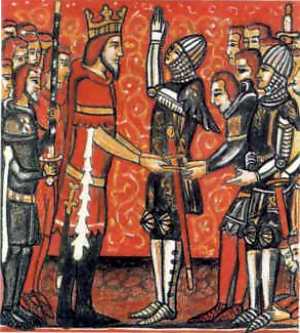
Roland pledges fealty to Charlemagne. Source: Wikipedia

Bastard Feudalism is a term I kept bumping into during my recent research into the fourteenth century. I finally had to stop and investigate. Just what is it, and how does it differ from feudalism as I’ve always known it? It turns out that this was originally used in the Victorian era; the term “bastard feudalism” was derogatory—implying a corruption of feudalism, debased and degenerate. But as time went on, historians came to define it more as a term implying a superficial imitation of the original social order, though different in its essence.

Just to review, Feudalism was brought to England with the Norman Conquest. Like everything else, I’m sure the Anglo-Saxons had a hard time making the adjustment, but the concept of Feudalism was harshly efficient. The king owned everything, and the system is based on land tenure (coming from the French word tenir—to keep), the relationship between the tenant and the lord. The king chose to lease out portions of his kingdom to loyal barons; in return they offered military service, paid rent, and served on the royal council. They had complete control of their Manor, as it was often called; they meted out local justice, minted coins, and collected taxes. The Baron, in turn, divided up a portion of his Manor among his knights, who agreed to offer protection and military service when called upon. The knights lorded it over their villeins, or serfs, who owed them service and provisions. This went on pretty much until the Black Death disrupted the abundance of available workers on the Manor and created a situation where cash was becoming more important than labor.

The term “bastard feudalism” was coined in 1885 by historian Charles Plummer, when he needed a term to define the changing relationship between lord and vassal in the two centuries after the death of Edward I. Slowly but surely, the tenurial bond gave way to a social tie depending on a personal contract. Mutual benefit became the keyword. Although military service was important, the relationship between master and retainer became more of a matter of reciprocal services; the lord offered patronage and contracted to protect and defend his vassal in court—maintenance—as well as in combat. He would pay his retainer an annuity, or a fee for specific services rendered; he would often feed and house his annuitant. The retainer was usually expected to contract for life, but by no means was this universal and the indenture was not expected to be binding on the heirs of either party. By the end of the fourteenth century, according to K.B. McFarlane (England in the Fifteenth Century, Collected Essays), there is “evidence to suggest that under the Lancastrians less permanent forms of contract were coming into favor.” Stipends were paid to household officers and servants, civil servants, surgeons, chaplains, falconers, cooks, and even minstrels.

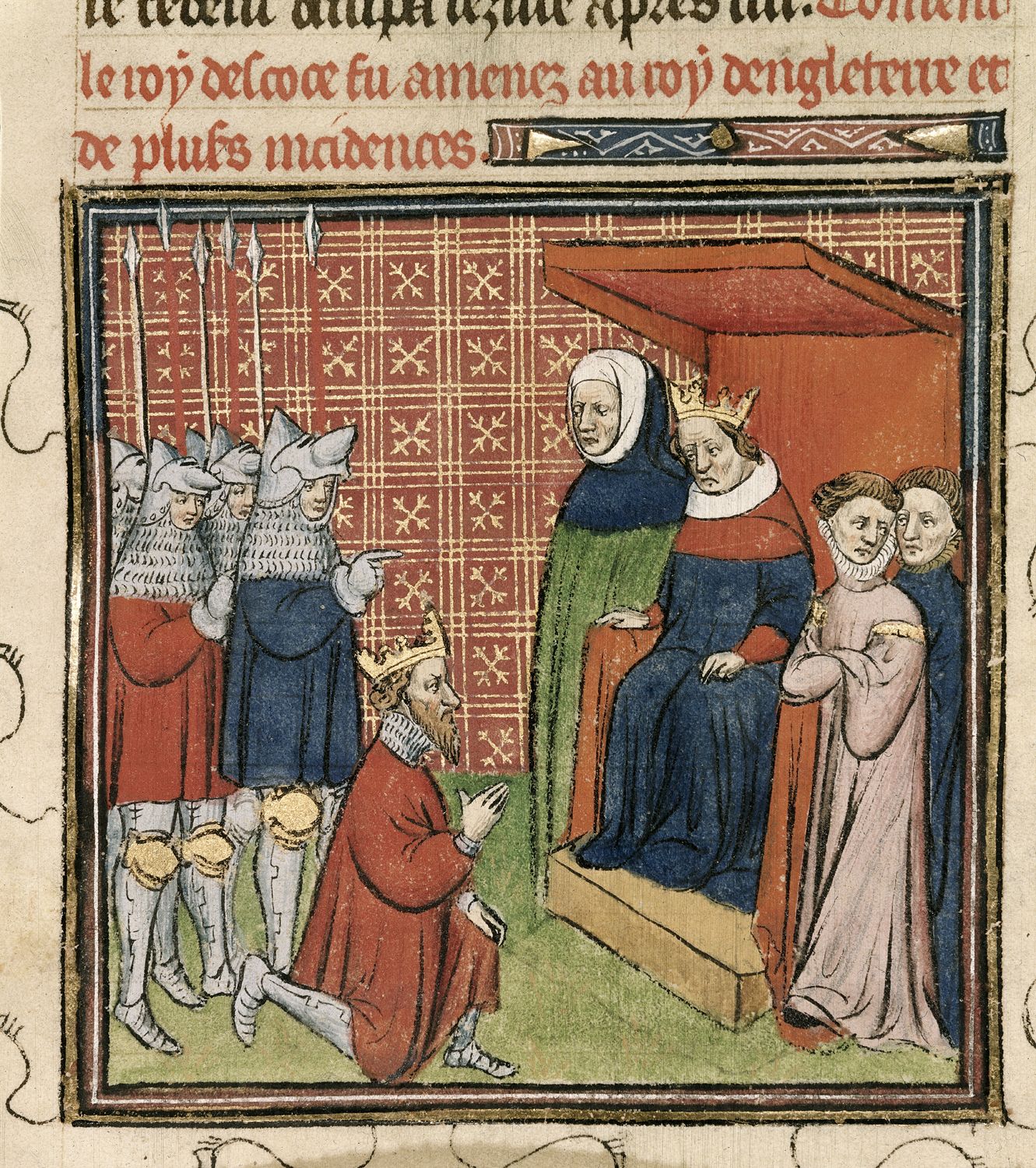
John Balloil before Edward I
John Balloil before Edward I, from BL Royal 20 C.VII, f.28

When it came to the lesser gentry, ties between them and the great lords often followed their feudal connections. According to Simon Walker (The Lancastrian Affinity 1351-1399), “bastard feudal loyalties were often the legitimate heirs of fully feudal ties. Precisely how often is rather more difficult to say. By the late fourteenth century, territorial proximity was usually more important than tenurial dependence in creating links between the magnates and the country gentry… it was the expectation of such additional fiscal benefits, not the mere possession of land, that bound the duke’s tenants more closely to his service.” At the same time, if a man owned several manors scattered throughout the country, McFarlane tells us “by this date tenurial relations were so interwoven that a man with several manors could scarcely avoid holding them of nearly as many lords.” If there was a potential conflict, one can only assume the vassal went with the lord who had the most to offer.

By Lancaster’s time, it was not at all unusual for a retainer to collect fees from more than one master for specific duties; think of today’s lawyers, accountants, or estate managers. This could very well be of benefit to both parties; the retainer could make money from several sources, and the magnate could stay informed. Simon Walker tells us, when Gaunt paid annuities to some of King Richard’s chamber-knights: “the king’s household was a center of gossip and accusations against the duke and it was by having his own men there that Gaunt was best able to thwart the efforts of his enemies.” It sounds a lot like spying to me, but if everyone agreed on the arrangement, I suppose it was routine.

From what I can gather, the whole concept of “bastard feudalism” is fluid; not every historian uses it, nor do we find an easy definition. It does make sense that cash was a strong incentive. It was a precious commodity and major magnates like John of Gaunt—not to mention the king—still represented a powerful influence.


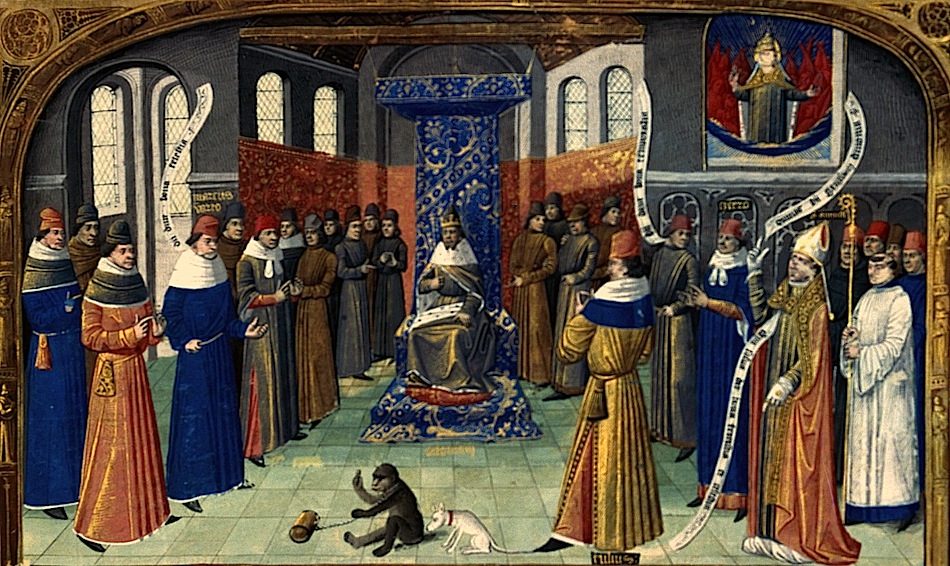
What was the Marshalsea court?

Mâcon, Bibl. mun., ms. 1, f. 211

Today when we hear about the Marshalsea we think of the infamous 19th century Southwark prison with all its associated tortures. But come back with me to the 14th century and you’ll see that the word has a totally different meaning—at first, anyway. Originally, the marshalsea (not capitalized—also known as the avenary) was the largest department of the household, in charge of taking care of the horses: feeding, grooming, and stabling. At the same time, the Marshal was a great officer of the royal and noble household, who functioned as the enforcer—the policeman, if you will—and the jailer. Where the Marshalsea (capitalized) came into play was in relation to the court of the verge (or the court of the steward and Marshal of the household). The steward presided over the court of the verge and the Marshal enforced its will.

The Marshalsea court can be traced back to the second half of Edward I’s reign; it was the legal arm of the household. In practice it tried cases involving servants of the crown, whether sinning or sinned against: theft, debts, contracts, acts against the royal dignity, and trespassing—anything short of murder. This involved activity that took place within the verge, which was a twelve mile radius from the king’s presence. If anyone refused to cooperate with the king’s servants—such as Purveyors—they could be tried at the Marshalsea court. Interfering with Purveyors was one of the bigger offenses. Their job was to gather supplies for the itinerant court, such as food, wood for heating, oats and hay for the horses, etc. and these purchases were almost always a bone of contention. They rarely paid in cash; instead, they often gave the long-suffering supplier a note to be cashed at the exchequer—when the funds were available, that is. The supplier could wait months to get paid, if he got paid at all. But if that long-suffering merchant refused to contribute,  the penalty could be severe. At the same time, the steward investigated complaints of extortionate behavior by the king’s servitors, though one can only wonder how often they decided in favor of the offended party.

Cases tried in the Marshalsea court were exempted from the common law courts; it became a separate tribunal, free from the technicalities and costs of traditional courts. Because of the itinerant nature of the king’s household, cases had to be tried quickly. Pleas of trespass and debt concerning outsiders often reverted back to the common law courts if the king moved on, taking the verge with him. Within the verge local officials were forbidden to trespass on the duties of the king’s officers; at the same time, they were found guilty of “contempt of the king” if they permitted the escape of suspected felons. There were plenty of conflicts between the local municipalities who wanted to try their own cases and who temporarily fell within the verge, and the government which didn’t always mind the boundaries.

Needless to say, the Londoners were often within the influence of the Marshalsea since the king was frequently in or near the city. Criminals were known to have crossed the Thames to Southwark to avoid punishment, since they could not be brought before the city authorities when the Marshalsea was present. The government tried to extend the Marshalsea’s jurisdiction into the city of London, but this was violently resisted and eventually dropped. Nonetheless, many formal protests were raised in successive Parliaments well into Henry IV’s reign. In 1373 Edward III ordered a building 40 feet long and 30 feet wide to be constructed “in the high street” for his own convenience, to hold pleas, keep prisoners, and hold other king’s courts.  It was one of the first of London’s symbols of oppression to suffer the wrath of the Peasant’s Revolt, though it was rebuilt the following year. The king’s sergeant-at-arms and keeper of the Marshalsea, Richard Imworth, was brutally murdered by the rebels two days after they destroyed the prison.

As time went on, reportedly by 1430, the Marshalsea became known as a debtor’s prison, and was notorious by the 18th century, when it was rebuilt about 130 yards south of its original site. You can learn all about it from Charles Dickens whose father was imprisoned there in 1824.


King Richard II’s Household: the Retinue

British Library: MS Harley 4205 f.6V

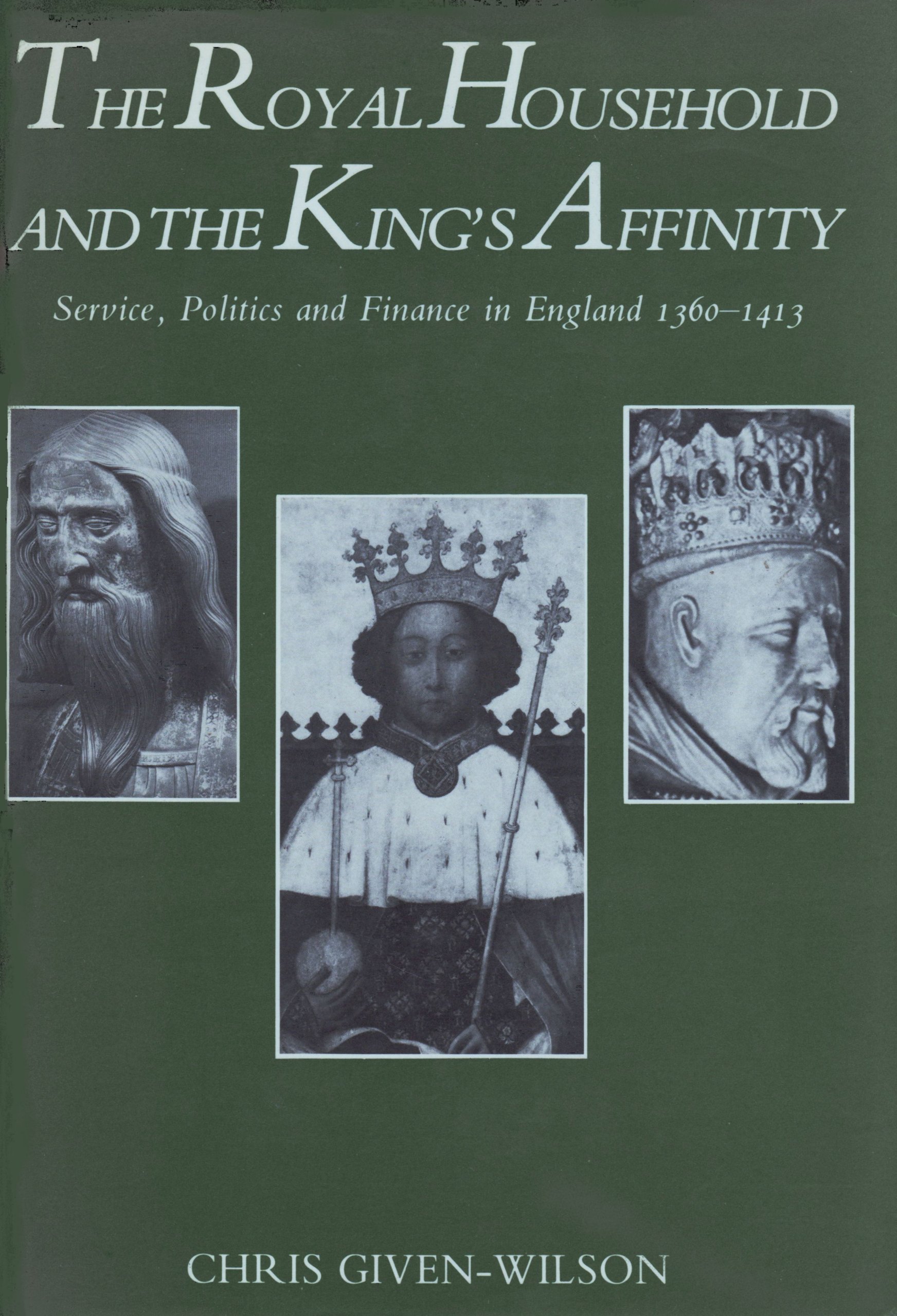
My interest in “The Royal Household and the King’s Affinity: Service, Politics and Finance in England 1360-1413” by Chris Given-Wilson goes way beyond what I can discuss in a book review. In Part One I talked about the king’s servants, from the lowest page to the great officers. When we move on to the chapters about the king’s affinity—or his retinue, for lack of a better word—we learn about the different layers of intimates: courtiers, knights, retainers, and so on. Some of them received annuities (the chamber knights) and some of them were only called upon in case of specific need and were paid accordingly.

The chamber knights were intimates of the king and were often sent away on special missions (as ambassadors, for instance, or in Burley’s case to negotiate his marriage). At the start of Richard’s reign there were about ten chamber knights, mostly left over from the Black Prince’s household; the most famous of them were also victims of the Appellants in 1388: Simon Burley and John Beauchamp of Holt. Two others were beheaded and three more were ordered to leave court. In the ’90s a new generation of intimates formed around the king—closer to his age—and by the end of Richard’s reign he had about 18 chamber knights in service. According to the author, “they actually had regular duties at court, either in the chamber or in the hall, and that they were obliged to remain at court for certain periods of each year (perhaps this was organized on a rotational basis, perhaps it was as other duties allowed, but certainly some of them would have been with the king all the time).” Chamber knights were rewarded with “temporary grants such as wardships, the custody of royal lands or castles (with attached fees), life annuities, and salaried posts in the king’s gift.” This was not a path to great landed wealth, though Richard did reward them whenever he could.

The author thinks about the royal affinity in terms of concentric circles around the king. The inner circle, most of the time, controlled access to the king—much to the annoyance of those who thought they deserved better. The king’s intimates—aside from chamber knights—were great officers of state, royal councilors, great magnates (in his favor), esquires of the chamber, and clerks of the royal chapel. Included among his inner circle were the bachelerii—or bachelors—”a distinct group of retainers in whom their lord reposed a special trust”. Some (perhaps all) were indeed chamber knights, but not all of them are recorded as receiving fees and robes. Perhaps they were just close personal friends; it’s difficult to say for certain. The second circle “may be defined as those who were bound to the king by ties of service, and by the fact that he paid them a regular wage…and expected them to serve him on a regular basis.” These included department officials, sergeants-at-arms, and lesser clerks; the majority of the household of 400-700 total belonged to this circle. The third (and outer) circle included those called upon for specific needs as mentioned above: the king’s knights, the king’s esquires, archers, and yeomen. They mostly did not live at the court and were called up as required, but here too there were layers of service. You had the bannerets (a superior rank of knight with a personal retinue of up to 20 men; he received 4s a day wages on campaign), simple knights (who received 2s a day on campaign), and esquires.

The king’s knights were the military men who mostly received annuities, “who were not of the royal household but who were attached to the person of the king”. After the episode with the Appellants, Richard started retaining knights for life; he realized that “he wanted to be sure of a loyal core of followers in a crisis” which was sorely lacking in 1387. In the last couple of years of his reign during his “second tyranny” he surrounded himself with the turbulent Cheshire archers, thus contributing greatly to the costs of the exchequer and wreaking havoc with the locals. In the same time frame he started retaining squires for life as well, in somewhat greater numbers; they were about half as expensive to maintain as knights.

So the king’s knights were among his lay courtiers. But not to be overlooked were his clerical courtiers, those of the king’s chapel, numbering up to 50 at any one time. The clerics were the ones who did the departmental work, i.e. clerks of the chancery, clerks of the exchequer, the privy seal office, the marshalsea, the chapel, etc. The clerical position was often a stepping-stone to higher religious posts, and they usually held prebends or canonries outside of the court from which they received the bulk of their livings. Many went on to be bishops; in fact, “by the end of the reign Richard had secured bishoprics for so many of his household clerks that the episcopacy must almost have come to resemble an extension of the household.” It is interesting that in his last few years, “the number of clerks among the king’s closest companions and advisors was considerably greater than the number of chamber knights”. They were to become a thorn in the side for Henry IV, many going so far as to assist the rebels in 1400.

It was contemporary opinion that Richard was much too impressionable and influenced by his “evil councilors”. It was the purpose of the Lords Appellant to remove his inner circle so they themselves could exert some influence over the king. They certainly succeeded in eliminating (one way or the other) more than 40 people from his household, but they fell short of their ultimate goal once he reached his majority and took control of the government in 1389.