Earl Siward of Northumbria and Malcolm III

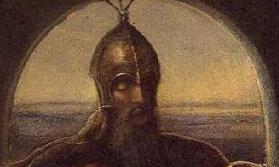
Earl Siward source: Wikipedia

After Alfred the Great established the Danelaw north of Watling Street, the Norse transformed themselves from raiders of Britain into settlers of north Britain…mostly.  As a result, the Viking chieftans ruled Northumbria for generations.

It is said that Siward might have come over with Canute, although others say his family had been in Britain for a few generations already.  I like the Scandinavian legend that he was descended from a white bear and a lady.  No wonder they called him “Siward the Strong”!  Nonetheless, it is undisputed that Canute made him Earl of York sometime around 1031, and he ruled Northumbria until he died.

I have read that he was somehow related by marriage to Malcolm III, which made him either an uncle or cousin.  When Macbeth killed Duncan and Prince Malcolm fled to England, it is believed he was taken in by Siward, who surely had it in his best interests to protect and nurture his future Royal neighbor.  As events played out, Siward invaded Scotland on Malcolm’s behalf in 1054, and together they won a great battle at Dunsinane which sent Macbeth into exile and established Malcolm as King of Cumbria, for starters.  Siward’s eldest son Osbeorn was killed in this battle.

Malcolm III became king of all Scotland after he eliminated both Macbeth and his stepson Lulach by the end of 1057.  Alas, Siward did not live to see Malcolm’s victory.  In 1055 he was stricken by dysentery, and as he lay on his sickbed, he bemoaned that after surviving so many battles he was forced to die like a cow.  Siward insisted that he be dressed in his armor, put on a helmet and took to hand an axe and shield so he could at least die like a warrior.  And so he passed from this world, leaving only a 10 year-old son Waltheof to survive him.

After the Norman Conquest, Malcolm was destined to meet Waltheof as a grown man and Earl of Northumbria, but was unable to return Siward’s favor and help Waltheof in his struggles against William the Conqueror.  Poor Waltheof was the last of the so-called Anglo Saxon earls, and had the dubious distinction of being the only English aristocrat to be executed in William’s reign.
Macbeth & Thorfinn of Orkney

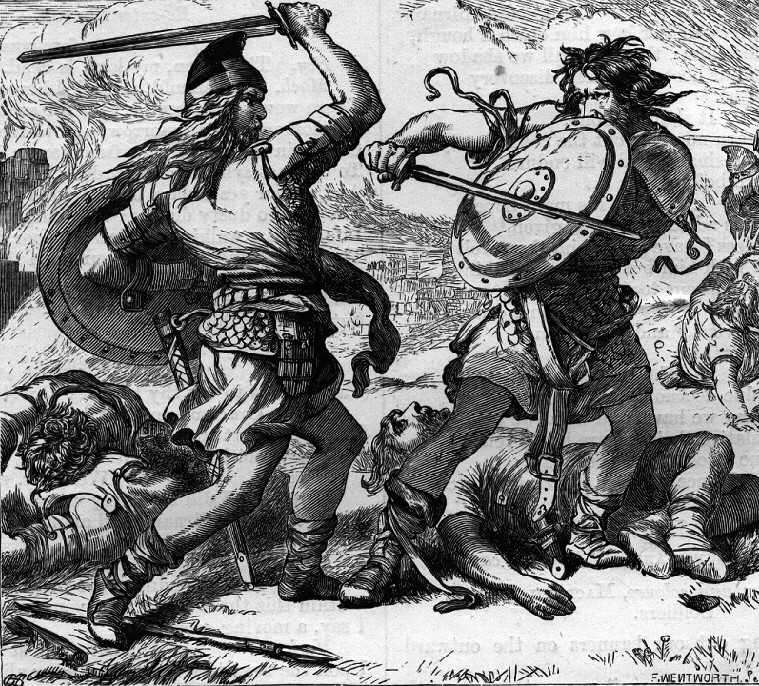
Macbeth fighting Malcolm III 19th cent. drawing by F.Wentworth

The relationship between Macbeth and Thorfinn Sigurdsson, Earl of Orkney is more than accidental.  Thorfinn – known to  historians as The Black – was grandson of King Malcolm II and may have been raised in Malcolm’s household.  However, he quickly became enemies with Malcolm’s heir Duncan I, who tried to claim the earldom of Caithness on his accession to the throne.  Thorfinn bitterly contested Duncan’s claims, and met him in battle at least twice, defeating the King’s forces both times.

Macbeth had a claim to the throne through his wife Grouch, and it is thought that Thorfinn and Macbeth became allies against Duncan.  Shortly after the King’s second defeat at Torfness, it is written that Duncan met Macbeth in battle at Pitgaveny on Aug. 15, 1040 and was killed on the battlefield.   This is a far cry from being murdered in his bed!

It is possible that after Duncan’s death, Thorfinn and Macbeth managed Scotland jointly, for it is said that at the height of his power, Thorfinn ruled 9 northern earldoms.  Historians have written that Macbeth and Thorfinn went to Rome on Pilgrimage together.  Some actually believe they were the same person, although I think this is a stretch.  Nonetheless, you can read a lively story to this effect in Dorothy Dunnett’s King Hereafter.

It’s possible that Earl Thorfinn Raven-feeder  came to Macbeth’s aid during the battle of Dunsinane.  He is said to have sailed up the Tay in support of Macbeth, and probably aided the King’s escape from the battle, leaving Malcolm III victor on the field.  I write about this at length in my upcoming book, Heir to a Prophecy.

What happened to Earl Godwine’s family?

Edward the Confessor accuses Earl Godwin of the murder of his brother, Alfred Aetheling, National Archives, UK

Godwine, Earl of Wessex was one of the most powerful Saxons of his day.  At the height of his career, it looked like he was positioned to found a powerful dynasty.  He had six strapping sons: Swegn, Harold, Tostig, Gyrth, Leofwine, and Wulfnoth, and his daughter Edith was married to the King of England.  It is sad and ironic that by the battle of Hastings, his family was either dead or scattered, and of course all the English Earldoms were dissolved by William the Conqueror, who divided the spoils among his followers.

Godwine’s eldest daughter Edith, Queen and wife to Edward the Confessor, survived until 1075—probably restricted to her Winchester estates—although it is difficult to find any reference to her after the Norman Conquest. King Edward is said to have hated Earl Godwine and resented being obliged to marry Godwine’s daughter; he needed the great earl’s support and may have agreed to wed the girl as one of Godwine’s conditions. Nobody knows for sure, but it is rumored he avoided her bed as much as possible (this adds to his saintly repute), though they seem to have had cordial relations.  She never gave birth to an heir, and hence the field was wide open after Edward died in 1066.

Swegn, the oldest son, was a constant source of trouble to his father.  He eventually committed the crime of abducting a nun, and later murdered his cousin Beorn, which precipitated the Witan’s declaration that he was nithing (wretch, coward; good-for-nothing). By the time of his father’s outlawry, he repented his sins and went on pilgrimage to Jerusalem from which he never returned.

The second son Harold succeeded Edward the Confessor, and was crowned King on Jan. 6, 1066.  His reign only lasted nine months, and he was killed at the Battle of Hastings on Oct. 14 in the same year.  His brothers Gyrth (Earl of East Anglia, Cambridgeshire and Oxfordshire) and Leofwine (Earl of Kent, Essex, Middlesex, Hertford, Surrey and probably Buckinghamshire) were also killed at Hastings.

Gyrth and Leofwine’s death at the Battle of Hastings, scene 52 of the Bayeux Tapestry. Source: Wikipedia

Tostig, the third son, was fiery and quick to anger.  When his brother Earl Harold was forced to side with his enemies and persuade King Edward to depose him as Earl of Northumbria, Tostig swore to come back and wreak revenge.  He accomplished this retribution by convincing Harald Hardraada to invade England in September 1066, where both the King of Norway and Tostig Godwineson met their deaths in battle at Stamfordbridge. Ultimately, this brought King Harold Godwineson north, leaving the coast unguarded at the moment William the Bastard crossed the Channel; Harold’s absence proved fatal to his kingship and the Saxon cause.

This left poor Wulfnoth, the only surviving son after the Battle of Hastings.  He had been a hostage in Normandy as long ago as possibly 1052, when the Normans fled England upon Godwine’s return from exile.  After Hastings, King William kept him confined, and on his death William Rufus brought him back to England and detained him at Winchester. It was possible Wulfnoth was permitted to join the monastery there, but regardless he was a comfortable prisoner all the way until his death in 1094.

Earl Godwine and Gytha had three other daughters: Gunhilda of Wessex, a nun who died in 1080, Aelfgifu, and Marigard.  It is probable that Gytha returned to her native Denmark after the Norman Conquest.


Were the Three Weird Sisters witches?

The Three Weird Sisters were the central theme to Macbeth, and yet reams of scholarly material have been written in an effort to determine their exact role.  Many believe that they were witches, especially considering the 16th century beliefs and witch hunts rampant under King James.  Did they cast a spell on Macbeth, or were they merely foretelling the future in the first act of the play?

It’s easy to take them at face value, considering Shakespeare’s use of spells and words commonly associated with witchcraft at the time.  If you want to get down to the “meat” of  the play (i.e. Macbeth’s murder of King Duncan), one can accept the Weird Sisters as witches and move on… no problem.  But this doesn’t explain their motivations: why would the witches wreak such havoc in the first place?  Just to stir things up, so to speak?

Another point of view is to associate the Weird Sisters with the fates.  The word weird has its origins in the Saxon word wyrd meaning fate, or personal destiny.  Some attribute the first modern use of the word to Shakespeare.

More to the point of my manuscript, the word wyrd  translates to Urðr  in Norse, namely one of the Norns of Scandinavian mythology who controlled the destiny of mankind.   The Norns are said to appear at the beside of a newborn and shape the child’s future.

It is possible that Shakespeare intended to portray the weird sisters as the Norns, shaping the destiny of the royal Stuart line which culminated in King James I, Shakespeare’s patron.  James is said to have claimed descent from Banquo.  Hence, their prediction “Thou Shalt ‘Get Kings, thou Thou be None”, the inspiration for HEIR TO A PROPHECY.

Dunfermline Tower of Malcolm III

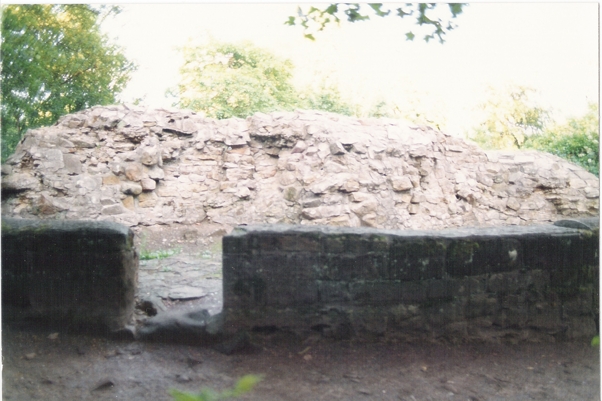
Malcolm III was said to have built his tower around the time he married Margaret Aetheling, c.1070.  You can still see its remains today when you walk from the famous Abbey (where Robert the Bruce is buried) through Pittencrieff Park and up to Tower Hill.

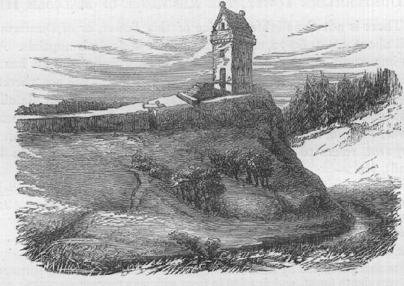
The tower measured about 48’x52′ and was thought to have had two stories and perhaps 20 small rooms plus servants quarters.  It was already perched about 70′ on a hill above a little stream, and may have been accessed by a drawbridge, which would have made it pretty well fortified.  Here is a 1790 engraving drawn by Mr. John Baine, Civil Engineer, Edinburgh:

Composition View of Malcolm Canmore’s Tower

Incidentally, the Pittencrieff estate was purchased and donated to the town of Dunfermline by Andrew Carnegie, who was born there in 1835.  Thanks to Carnegie, everyone can enjoy the park and castle ruins that were closed to the public when he was a child.

Canute’s Trench

Said to be four miles long

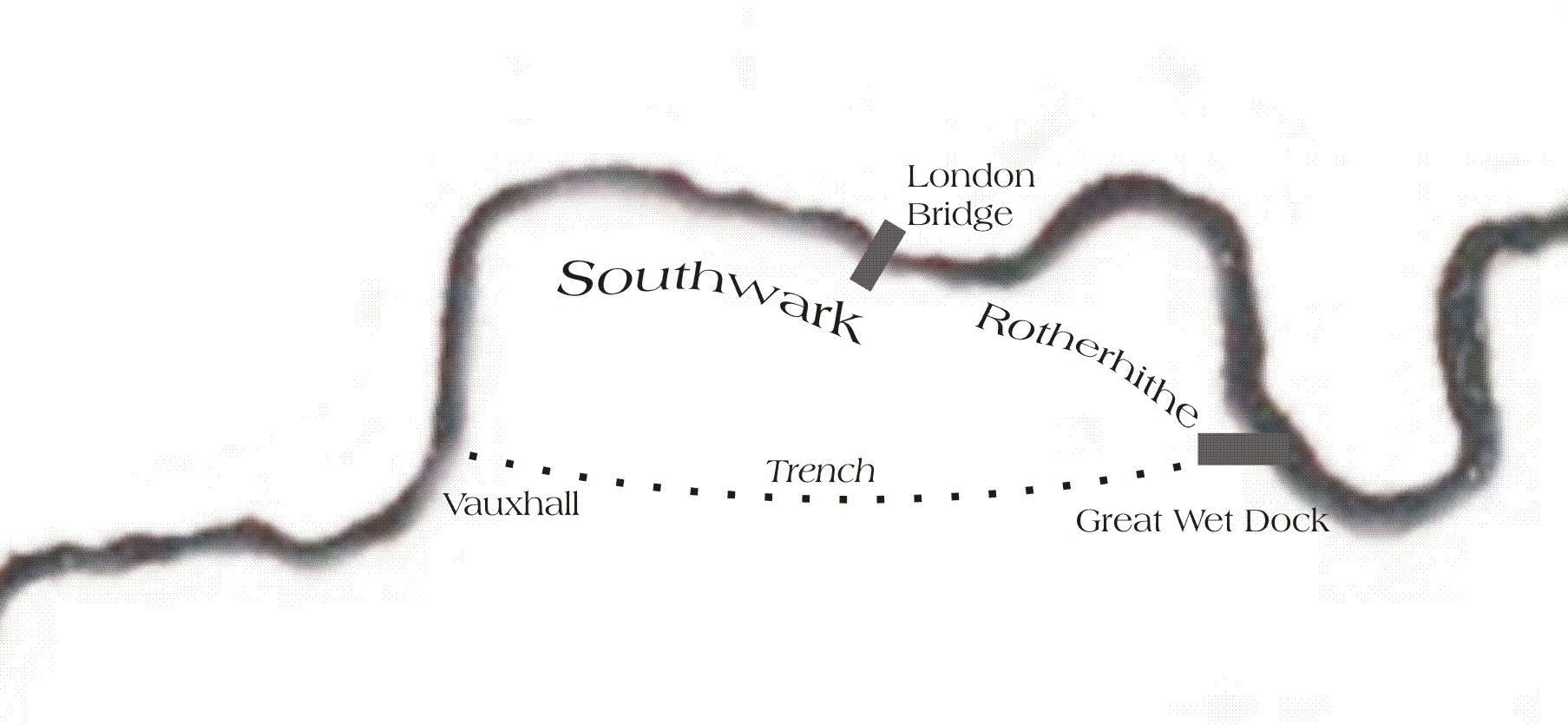
In 1016 Canute had returned to England to reclaim the throne his father had won three years before.  He had a formidable rival in Edmund Ironside, son of Aethelred the Unready.  Edmund stoutly defended London, and London Bridge blocked Canute’s passage up the river.  This wooden bridge joined the walled city to the suburbs of Southwark, which were protected, in turn, by raised Roman roads that provided a system of dykes to keep out the tidal waters.

There is very little agreement as to how he did it, but most historians believe that Canute’s men dug a trench, or a canal around Southwark, through the marshes, ending at Vauxhall and bypassing the bridge. He then totally encircled the city of London and laid siege.

In the course of writing about this feat, I keep wondering about how they managed to get so many shovels?  They certainly didn’t go to Home Depot and clean out the inventory.  Did they raid the locals and appropriate all the Saxon’s tools?  Did the put the locals to work?  Or can we assume that the Northmen expected to lay siege and packed shovels onto their ships before they left home?  How much stuff could they carry on those shallow vessels?

In the end, he raised the siege anyway, so what a lot of trouble for nothing!

London Bridge is Falling Down

1014 was a busy time for Londoners. The year before, Swegn Forkbeard, their unwelcome new king had died after only 5 months on the throne, and Aethelred wanted his crown back. But the Vikings were still in possession of the city, and they had other ideas. This time they were the ones defending London, and the attackers were Aethelred the Unready and his ally King Olaf of Norway.
Aethelred and Olaf were clever fellows and they protected their ships with thatched roofs pulled from buildings downstream. The bridge was packed with stout Vikings throwing everything they had onto the Saxon ships, who were busy tying ropes to the bridge piles. They rowed with all their might, taking advantage of the tide, and were able to pull out the supports, tearing the bridge down and everyone on it.  London threw open the gates and welcomed their old king back in, and the Northmen went away, only to return two years later with Canute and start all over again.
Many historians think this is where the nursery rhyme came from!

Right Location, Different Era

Rhuddlan Castle

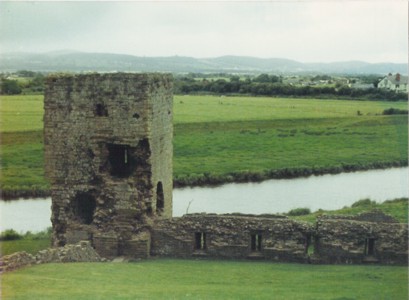
Rhuddlan Castle, Clwyd, North Wales.  Just rolls off the tongue!  On the coast of north Wales next to the river of the same name, Gruffydd ap Llewelyn had a fortress from which he could launch his raids into England.  He lost it to Harold Godwineson, who descended on his palace during Christmas festivities and nearly caught the Prince at home, but for a timely warning that sent all the inhabititants scurrying for safety to the Irish sea.  Harold burnt the Princely seat to the ground.   200 years later, Edward I built a castle very near the same spot, and this is a corner outpost of the great fortress, giving access to the river.  The emerald green view over the fields of Wales is quite unforgettable (even on a cloudy day).  It wasn’t difficult to imagine Prince Gruffydd standing on his wooden tower and looking at the same sight.

Was Malcolm III Illegitimate?

As we all know, history was written by the last man standing, so to speak.  Such is the case with Malcolm III Canmore.  As the eldest son of Duncan II, Malcolm was the heir who claimed Scotland from the usurper Macbeth.  Where did this rumor come from that he was the illegitimate son of Duncan and the miller of Forteviot’s daughter?  I wonder if it was put about by his younger brother Donald Bain (or Donald Bane), who took the crown for himself after the death of Malcolm, putting aside the claims of his nephews.  From what I can tell, his alleged illegitimacy was not claimed during his lifetime, which could have been a great coup for William the Conqueror.  And it certainly did not stop Malcolm’s sons from stepping up to the throne after Donald Bain’s demise.

The supposed illegitamacy was mentioned in the “Chronicle of Andrew of Wyntoun” c.1420, who claimed King Duncan fell in love with the Miller’s daughter and gave her a child.  There is a place in Forteviot called Miller’s Acre, which could refer to this event.  I did visit this sleepy little village, myself, but aside from a plaque indicating that the town was once associated with a royal seat, I found nothing that could enlighten me as to Malcolm’s rumored beginnings.

Finding Macbeth’s Dunsinane

Dunsinane Hill
A big hill but where are Macbeth’s Castle ruins?

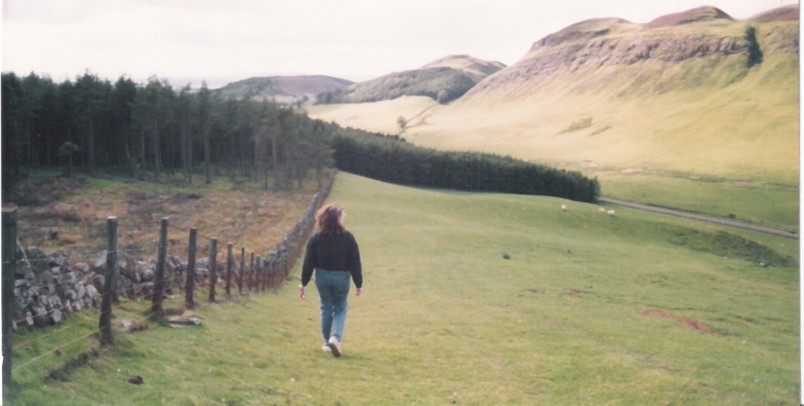
Many years ago I embarked on that elusive journey to find the locations for my book-in-progress, HEIR TO A PROPHECY. I thought Dunsinane would be easy; after all, I only needed to find Birnam Wood, right? Well, imagine my surprise to find two Dunsinane sites…or was it Dunsinnan? There were two locations on the Geological Survey map, both within shouting distance of Perth. So I dutifully visited both hills, expecting – or rather hoping – to find something resembling castle ruins.

Much to my surprise, I found nothing that I could even vaguely recognize as a stone foundation, wall, or any evidence of historic habitation. Where was Macbeth’s castle? I could only assume that Shakespeare loved the sound of the word Dunsinane and really, did it matter if Macbeth built a castle there or not? Yielding to common sense, I located a likely site, Kinfauns castle located on a cliff overlooking the Tay; the current tower was built in the early 19th century as Lord Grey’s architectural folly, but it is thought to be on the site of a medieval stronghold. Good enough for me!

Imagine my relief, after the fact, to discover mention in the book I was reading, BLOODFEUD by Richard Fletcher: “As commander-in-chief of a combined land and sea force…he (Siward) invaded Scotland and defeated Macbeth in a hard-fought battle. (Its site is not known: Dunsinane, properly Dunsinnan, is a later improvisation).” Whew.

I was much more gratified to find the foundations of Malcolm III’s tower at Dunfermline hill, which still stand proudly with a sign and a recognizable footprint…all of three feet high. At least I was on the right track; only 1000 years later, traces of a well-built castle should be identifiable.